Parece que falei cedo demais. Tudo parecia estar bem, mas, quando se trata de glossificação, parece que o interlinearizer está considerando apenas a morfologia do radical e não os afixos. Portanto, embora os afixos estejam corretamente inseridos, frustrantemente, eles não aparecem nas sugestões de glossa, apenas o radical.
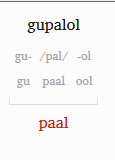
Na captura de tela abaixo, a palavra “gupalol” no idioma de origem tem corretamente a morfologia gu- pal -ol. No idioma de destino, esses morfemas estão corretamente marcados como gu- paal -ool. Apesar de eu ter aceito os morfemas no idioma de destino como corretos, a linha de glossa mostra apenas “paal”, enquanto meu entendimento é que ela deveria combinar os morfemas e fornecer o resultado correto, a saber, “gupaalool”. Esse é o caso para todas as novas palavras que tento analisar. Passei muito tempo procurando nos arquivos do Paratext, mas não consigo descobrir o que, se houver algo, precisa ser alterado, então apreciaria muito a ajuda. Obrigado
It seems I spoke too soon. Everything looked ok, but when it comes to the glossing it appears the interlinearizer is only taking into account the morphology of the stem and not the affixes. So although the affixes are correctly entered, frustratingly, they do not appear in the gloss suggestions, only the stem.
In the screenshot below, the word “gupalol” in the source language correctly has the morphology gu- pal -ol. In the target language these morphemes are correctly marked as gu- paal -ool. Despite me having accepted the morphemes in the target language as being correct, the gloss line just shows “paal”, whereas my understanding is that it should take the combination of morphemes and provide the correct result, namely “gupaalool”. This is the case for all new words that I try to parse. I have spent a long time searching in the Paratext files, but cannot work out what if anything needs changed, so would greatly appreciate help. Thank you








