0 votes
367 vues

Where does the “parse gloss” line in the interlinearizer take its information from internally? I started trying out an adaptation using the interlinearizer with PT 9.1 and since the update to PT 9.2 changed things I think I have now managed to mostly get back to the settings I had, but I now find myself with strange information in the 3rd line as shown in the picture, which I understand is the “parse gloss” line. What can I do about this?

Paratext par (424 points) | 367 vues

2 Réponses

0 votes
Meilleure réponse

Thanks to a reply on another thread and a link posted there, I managed to follow the instructions for changing the language code in the various different files as posted here, in my case the internal data was incorrectly set as French, but having corrected it to the vernacular language, I believe everything is back to how it should be.

par (424 points)
0 votes

It seems I spoke too soon. Everything looked ok, but when it comes to the glossing it appears the interlinearizer is only taking into account the morphology of the stem and not the affixes. So although the affixes are correctly entered, frustratingly, they do not appear in the gloss suggestions, only the stem.

In the screenshot below, the word “gupalol” in the source language correctly has the morphology gu- pal -ol. In the target language these morphemes are correctly marked as gu- paal -ool. Despite me having accepted the morphemes in the target language as being correct, the gloss line just shows “paal”, whereas my understanding is that it should take the combination of morphemes and provide the correct result, namely “gupaalool”. This is the case for all new words that I try to parse. I have spent a long time searching in the Paratext files, but cannot work out what if anything needs changed, so would greatly appreciate help. Thank you

image

par (424 points)

Hello, I had the same problem and this was what Doug Higby sent back in December which helped me fix the problem:

Your interlinear data is stored in the database and tagged with the language of the glosses. You can look in your Paratext project directory to see what language code(s) your existing interlinear has been tagging the glosses with.
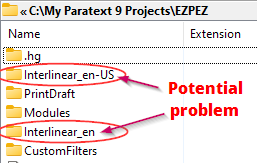
image
Let’s say that all your glosses went missing after upgrading to 9.2 and reopening the interlinear. If you haven’t worked yet in the new blank interlinear, you will only have one directory showing here, en-US. The one with the language tag you have been using. To see your glosses again, you will need to create a new interlinear in one of two ways:

  1. Create an interlinear with no model text, and select en-US as the language.
    OR
  2. Create an interlinear with a model text that is en-US. You can see the language of the model text in the Open Resource dialog: image

If you have two interlinear_XYZ directories and don’t know which is the language code you have been using, just open each directory and see which one has more files, and with past dates. In the screenshot at top, the Interlinear_en folder had only one file in it that was only 500bytes in size. The other one had multiple books with larger file sizes. Clearly, en-US is the language I need to select when setting up the interlinear if I want to see my glosses back.


If you are still having this issue, could you add the user Paratext Support as an Admin to the relevant projects and we can take a look at it?

Questions connexes

0 votes
8 réponses 925 vues
Since I upgraded to Pt 9.2, I can't get the data I had previously entered (over several years) to show up in the ... , but alas, I still don't have access to the parse glosses.
anon570831 121 posée déc. 13, 2021
0 votes
1 réponse 344 vues
In PT 7.5 it was possible to have only one parse per word. If I changed my mind about how to gloss a word I could ... , then I'd like to make a feature request for this, please.
KimB 670 posée août 15, 2017
0 votes
3 réponses 362 vues
What is the order of the suggested glosses in the interlinearizer tool? In other words, if you click a gloss and ... frequency, though that seems like it would be most logical.
mnjames 1,9k posée sept. 11, 2018
0 votes
3 réponses 850 vues
We have a project with 4 translators entering glosses in the Interlinearizer as we adapt from a related language. Because the ... of the program? They use PT 7.5. Iver+Larsen
Iver Larsen 869 posée oct. 3, 2016
+2 votes
1 réponse 185 vues
The Paratext interlinearizer is a source for vernacular words and their glosses that can be used to begin making ... http://lingtransoft.info/apps/paratext-lexicon-extraction-tool
[Expert]
Jeff_Shrum
2,9k
posée déc. 8, 2016
Welcome to Support Bible, where you can ask questions and receive answers from other members of the community.
Give proper recognition to those widows who are really in need.
1 Timothy 5:3
3,044 questions
6,003 réponses
5,671 commentaires
2,026 utilisateurs




