Un usuario pidió ayuda porque Paratext le indicaba ‘separador de versículo no válido: -’ aunque había verificado que - se había introducido como separador del rango de versículos.
Revisé el proyecto y tampoco pude ver cuál era el problema. Finalmente, noté la curiosa información emergente (tooltip) que aparecía para ese cuadro. ¿Qué podría significar “00ad002d”? Entonces me di cuenta de que esta información mostraba el valor Unicode de los caracteres en el cuadro. De alguna manera, este proyecto había obtenido dos caracteres en el campo de rango de versículos: 00AD (guion discrecional) y 002d (guion regular). El guion discrecional no es visible, por lo que simplemente parecía un -, pero Paratext también estaba buscando el guion discrecional junto con el - y no reconocía el - por sí solo. Cuando eliminé ambos caracteres del cuadro y luego escribí - de nuevo, ahora reconocía las referencias.
Pensé que esta era una nueva función agradable en la versión 9.1, pero lo verifiqué y en realidad ya está presente en Paratext 8. Simplemente no lo había notado.
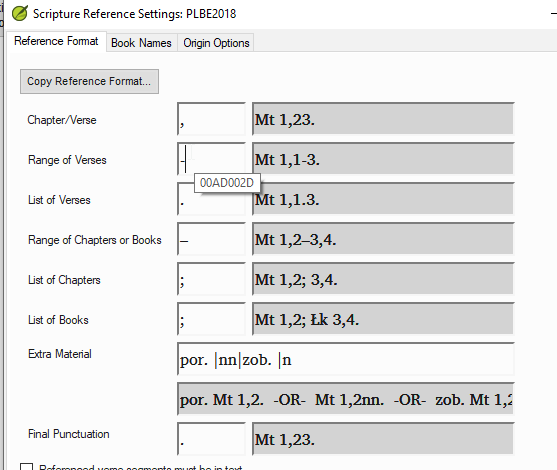
A user asked for help that Paratext was saying ‘invalid verse separator: -’ when they had verified that - was entered as the verse range separator.
I looked at the project and couldn’t see what the problem was either. Finally I noticed the curious tooltip that appeared for that box. What could “00ad002d” mean? Then it dawned on me, this tip was showing the Unicode value of the character(s) in the box. somehow this project had gotten two characters in the verse range field; 00AD (discretionary hyphen) and 002d (regular hyphen). The discretionary hyphen is not visible, so it just looked like - but Paratext was also looking for the discretionary hyphen with the - and not recognizing - by itself. When I deleted both characters from the box then typed - again, it now recognized the references.
I thought this was a nice new feature in 9.1, but I checked and it actually is there in Paratext 8. I just had not noticed it.
Traducción automática desde English








