嗯。我认为现在不建议要求翻译使用特定字体。如果它使用变音符号(两点)的代码点并将其显示为波浪号,那么它甚至可能是一个前 Unicode 或仅半 Unicode 的字体。
因此,我建议你将整个项目的底层文本转换为真正的 Unicode。这里或 Paratext 网站上可能有人可以帮你完成这项工作。
但让我们假设,出于美观原因,你需要使用一个特定字体,而该字体对某些字母使用了错误的字形。
启用完整菜单后,你会看到高级选项卡,你会看到一个应该设置的复选框,“Apply changes.txt”:
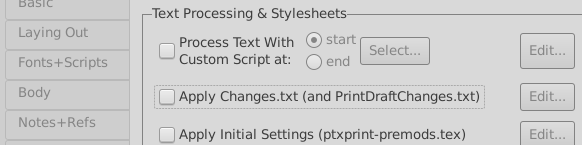
在该文件中(点击编辑),你可以应用常规更改,每行一个,并且可以将更改限制在单个经文。
基本格式是 "old" > "new",你可以通过在数字前加 \u 来指定 Unicode 代码点。例如:
"dh" > "ð"
"th" > "θ"
"\uA78C" > "\u0027"
Hmm. I don’t think it’s recommended to require a specific font for a translation these days. It sounds like it might even be a pre-unicode or only semi-unicode font if it is using a code-point for dieresis (2 dots) and showing it as a tilde.
I would therefore encourage you to make the underlying text of the whole project into true unicode. Probably there are people here or on the Paratext site who can help you do that.
But, let us assume that for aesthetic reasons you need to use a specific font, which is using the wrong glyphs for certain letters.
Enabling full menus, you will see the advanced tab, you will see a checkbox you should set, ‘Apply changes.txt’:
In that file (click on edit), you can apply regular changes, one per line, and also restrict the change to just a single verse.
The basic format is "old" > "new", you can specify unicode code-points by prefixing the number with \u For example:
"dh" > "ð"
"th" > "θ"
"\uA78C" > "\u0027"
机器翻译自 English








