Paratext 的 send/receive 功能倾向于使用节号来帮助解决冲突,文档也警告说,因此两个人同时编辑词汇表是危险的。我推测这并没有针对词汇表明确关闭,只是通常那里没有节号。我想针对这个问题提出以下方法:
步骤 1:使用节号(这为 paratext 提供了一种导航方法)在首字母边界处拆分词汇表。
步骤 2:使用 \vp 将数字替换为相应的大写字母
例如:
\zglo-s\*
\pc
\v 1 \vp A\vp*
\p
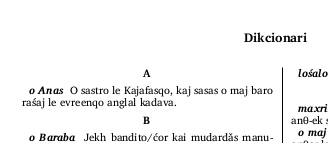
\k o Anas\k* O sastro le Kajafasqo, kaj sasas o maj baro raśaj le evreenqo anglal kadava.
\pc
\v 2 \vp B\vp*
在格式方面,将整个词汇表包裹在一个范围里程碑中(我选择了 \zglo-s....\zglo-e),然后您的 custom.sty 文件可以是这样的:
\Marker zglo-s
\Endmarker zglo-e
\Name Glossary section
\Description So special formatting can be applied within glossary
\StyleType Milestone

\Marker v+zglo-s
\Superscript -
\Bold
(上述文件的最后一部分使里程碑范围内的“节号”变为正常大小并加粗)
Paratext send/receive likes to use verse numbers to help solve conflicts, and the documents warn that 2 people editing the glossary is therefore dangerous. I presume that this is not explicitly turned off for the glossary but just normally there are no verse numbers there. I’d like to suggest this approach to that problem:
Step 1: Split the glossary at initial-letter-boundaries, using verse-numbers (which provide a navigation method for paratext).
Step 2: Use \vp to replace the number with the appropriate initial letters
E.g:
\zglo-s\*
\pc
\v 1 \vp A\vp*
\p
\k o Anas\k* O sastro le Kajafasqo, kaj sasas o maj baro raśaj le evreenqo anglal kadava.
\pc
\v 2 \vp B\vp*
For formatting, enclose the whole glossary in a ranged milestone (I’ve chosen \zglo-s....\zglo-e), and then this could be your custom.sty file:
\Marker zglo-s
\Endmarker zglo-e
\Name Glossary section
\Description So special formatting can be applied within glossary
\StyleType Milestone

\Marker v+zglo-s
\Superscript -
\Bold
(The last part of the file above makes ‘verse numbers’ within the bounds of the milestone normal sized and bold)
机器翻译自 English