0
407 次瀏覽

Today, from a real bit of text, I hit upon a new question:

Do I need to give each morpheme on each wordlist-entry, or can I work in a hierarchic fashion? I did not find anything on this in the help.

Example:

Already existing entry: thought (faŋa)

Also already existing entry: plural-marker+ thought (=thoughts) (a+ faŋa)

Today I need to enter: their thoughts. So can I enter

their+ thoughts (b+ afaŋa)

or do I need to enter

their+ plural-marker+ thought (b+ a+ faŋa)

I woulɖ not mind either way, but am curious of what PT8 can handle. And what advantages and disadvantages other users have found for either approach.

Can we agree that for HTML the CSS are an established working system, where the “C” is indeed helpful? It is on this background that I wonder how to handle all those regular nouns, plural-nouns, and all those possible prefixes in PT8.

Thank you.

舊文章 - 以原文顯示
Paratext (934 點) 提出
已重新顯示 | 407 次瀏覽

2 個回答

0
最佳回答

I am using the Biblical Terms based on stems/roots. If this is what you are interested in, then the answer is that PT is not hierarchic as far as I can see. Unlike AMPLE which is a powerful analyzer that reads from a root dictionary, a prefix dictionary and a suffix dictionary plus rules, PT is simple in that it works from a root/stem indicated in the Wordlist and ignores whatever prefixes and suffixes may be given.
In your example, the root is faŋa. For afaŋa you write a+ faŋa in the morphology column of the Wordlist. For bafaŋa you can write either b+ a+ faŋa or ba+ faŋa. PT only looks for the root/stem and the complete word. How many prefixes and suffixes there are is irrelevant. If you write b+ afaŋa you are telling PT that you have both a root faŋa and a stem afaŋa, so you would need to list both as definitions for thought(s) in the Biblical Terms. If you break down as b+ afaŋa, it cannot find bafaŋa from the root faŋa, only from the stem afaŋa. In my view that is not the best option, so I would write b+ a+ faŋa.
I do mark the various prefixes and suffixes because I like to have a record of the correct morphological breakdown, so a word like musatiinakwaa (their traps) I write as musat +iin +ak +waa (root, class marker, plural marker, possessive.) But PT is only interested in the root musat (which never occurs in this form except as a root in the Wordlist) and the fuil word musatiinakwaa. When musat is given as a definition in the Biblical Terms tool and as long as the words musatiinaa, musatiinak, musatiinacaato, musatiinakaap, musatiiŋwaa, musatiit, musatiitaap are all indicated in the Wordlist with the root musat, PT will happily find all these forms in the Biblical Terms check.
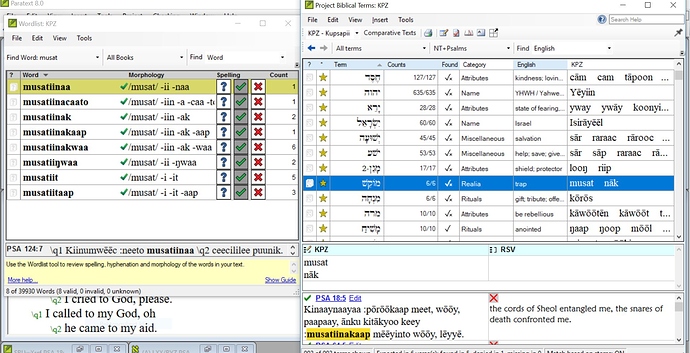

However, it will not find those places where we use the word for a different Hebrew or Greek term, because the Biblical Terms go by Hebrew words and Hebrew has various words for a trap or snare. So, in the screenshot you should see 8 words from the root musat. However, if I hold the cursor over the vernacular column in the Biblical Terms window I can see that it only found 4 of the 8 words, since the Wordlist is based on the vernacular and the Biblical Terms on the Hebrew/Greek. We also use a different word (stumbling block) for the same Hebrew word. It is complex, because we translate by context, not with word-for-word equivalents.

舊文章 - 以原文顯示
(869 點) 提出

Great, thank you. Since you show so many words in the corner of your screenshot, please allow a practical question:

In each key-terms-work-session there is a need to hop from the key-terms-window to the relevant entry in the word-list, whenever the morphology is not yet entered or not confirmed.

I know how to click on the blue verse-link, find myself in the main text, right-click on the actual rendering (a word) and select go to wordlist. Many clicks times many key terms…

I cannot right-click and jump from the text which is shown in the bottom part of the key-terms-window.

Is there a more efficient way to go from the key-terms window to a certain entry in the wordlist?

舊文章 - 以原文顯示

I am not aware of a more efficient way. I assume you are aware of the option to pin the window so that it is not minimized when you go to the main text window. Otherwise, you may try to complete the Wordlist before working on the Biblical Terms so that almost all words will already have an approved morphological breakdown.

舊文章 - 以原文顯示
+1

No, Paratext does not work in that hierarchic fashion that you described. However, it should hopefully learn as you go, so it would start suggesting (b+ a+ faŋa) as its guess so you just have to press the OK button making it faster/easier the more you do.

舊文章 - 以原文顯示
[Expert]
(16.7k 點) 提出

相關問題

0
2 個回答 301 次瀏覽
在我們處理的語言中,某些附綴和黏著詞素與詞幹之間以連字號分隔 此連字號在語言設定中被定義為詞中標點 現在,Paratext 的形態分析欄位有時會做出錯誤的猜測,因為它忽略了這類連字號 例如,它將 khøuwa-te 的形態猜測為 / ... 的形態分析猜測器不會將任何包含連字號的字串視為單一詞素? 如果沒有,我打算建議增加此功能 謝謝, rfkvg
Roland 245 提出 已提問 12月 1, 2021
0
2 個回答 504 次瀏覽
我正在處理一個已經包含具有形態學斷詞的詞彙表專案 是否有可能將該詞彙表載入到詞彙表(Wordlist)工具中?對於連字號(hyphenation),有一個 hyphenatedWords.txt 檔案 是否有類似的檔案用於形態學資料? @anon291708 出於好 ... 料夾中任何地方都看不到詞彙表資料 如果能有一個關於其運作機制的簡短教學,將不勝感激
Kent Spielmann 1.8k 提出 已提問 3月 30, 2021
0
4 個回答 668 次瀏覽
這個專案使用基於詞根(stem-based)的設定,已經順利運行數週了 這種語言會產生許多複合詞 它們可以是名詞 動詞 形容詞以及「更複雜情況」的任意組合 當然,這些元素結合的方式有「規則」可循,邏輯清晰,且每 ... 想像一種語言,他們說 overmother ,其中 mother 是意為母親的詞根,而 over 是意為 μέγας 的前綴 )
Tim 934 提出 已提問 4月 24, 2019
0
2 個回答 641 次瀏覽
我目前正在處理詞彙表(Wordlist),為了確保我使用的是最新版本,我剛安裝了 Paratext 9.2 在詞彙表形態欄位中,關於 Aezek (這是 Isaac 的音譯)有兩個出現記錄如下: /aezek/ ; /Aezek/' 如果我點 ... 照表就會消失 如果您對這些問題中的任何一個有任何見解,我非常希望能聽到您的意見 謝謝 rfkvg
Roland 245 提出 已提問 11月 30, 2021
+1
3 個回答 483 次瀏覽
我們地區的一位語言學家正在思考使用 Paratext 形態學功能的最佳方式 她主要使用這些功能來協助拼字檢查,但也用來確認譯者所做的選擇類型 我不認為她會使用形態學來處理聖經術語(Biblical Terms)等事項 在嘗試協助她時,我面臨的 ... 態學做出有依據的猜測(以及可能的逐行對照猜測)?它如何處理在表面形式中看起來與底層形態素差異很大的情況?
Stephen Katt 1.3k 提出 已提問 10月 7, 2020
Welcome to Support Bible, where you can ask questions and receive answers from other members of the community.
So Peter was kept in prison, but the church was earnestly praying to God for him.
Acts 12:5
3,049 個問題
6,007 個回答
5,673 則評論
2,029 位使用者





