0 голосов
406 просмотров

Today, from a real bit of text, I hit upon a new question:

Do I need to give each morpheme on each wordlist-entry, or can I work in a hierarchic fashion? I did not find anything on this in the help.

Example:

Already existing entry: thought (faŋa)

Also already existing entry: plural-marker+ thought (=thoughts) (a+ faŋa)

Today I need to enter: their thoughts. So can I enter

their+ thoughts (b+ afaŋa)

or do I need to enter

their+ plural-marker+ thought (b+ a+ faŋa)

I woulɖ not mind either way, but am curious of what PT8 can handle. And what advantages and disadvantages other users have found for either approach.

Can we agree that for HTML the CSS are an established working system, where the “C” is indeed helpful? It is on this background that I wonder how to handle all those regular nouns, plural-nouns, and all those possible prefixes in PT8.

Thank you.

Старое сообщение — показано на исходном языке
Paratext от (934 очков)
снова показан | 406 просмотров

2 Ответов

0 голосов
Лучший ответ

I am using the Biblical Terms based on stems/roots. If this is what you are interested in, then the answer is that PT is not hierarchic as far as I can see. Unlike AMPLE which is a powerful analyzer that reads from a root dictionary, a prefix dictionary and a suffix dictionary plus rules, PT is simple in that it works from a root/stem indicated in the Wordlist and ignores whatever prefixes and suffixes may be given.
In your example, the root is faŋa. For afaŋa you write a+ faŋa in the morphology column of the Wordlist. For bafaŋa you can write either b+ a+ faŋa or ba+ faŋa. PT only looks for the root/stem and the complete word. How many prefixes and suffixes there are is irrelevant. If you write b+ afaŋa you are telling PT that you have both a root faŋa and a stem afaŋa, so you would need to list both as definitions for thought(s) in the Biblical Terms. If you break down as b+ afaŋa, it cannot find bafaŋa from the root faŋa, only from the stem afaŋa. In my view that is not the best option, so I would write b+ a+ faŋa.
I do mark the various prefixes and suffixes because I like to have a record of the correct morphological breakdown, so a word like musatiinakwaa (their traps) I write as musat +iin +ak +waa (root, class marker, plural marker, possessive.) But PT is only interested in the root musat (which never occurs in this form except as a root in the Wordlist) and the fuil word musatiinakwaa. When musat is given as a definition in the Biblical Terms tool and as long as the words musatiinaa, musatiinak, musatiinacaato, musatiinakaap, musatiiŋwaa, musatiit, musatiitaap are all indicated in the Wordlist with the root musat, PT will happily find all these forms in the Biblical Terms check.
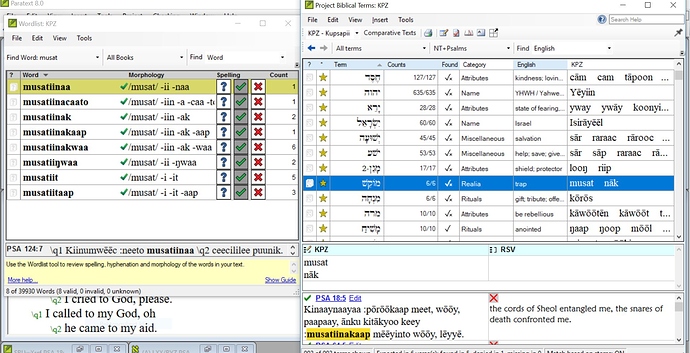

However, it will not find those places where we use the word for a different Hebrew or Greek term, because the Biblical Terms go by Hebrew words and Hebrew has various words for a trap or snare. So, in the screenshot you should see 8 words from the root musat. However, if I hold the cursor over the vernacular column in the Biblical Terms window I can see that it only found 4 of the 8 words, since the Wordlist is based on the vernacular and the Biblical Terms on the Hebrew/Greek. We also use a different word (stumbling block) for the same Hebrew word. It is complex, because we translate by context, not with word-for-word equivalents.

Старое сообщение — показано на исходном языке
от (869 очков)

Great, thank you. Since you show so many words in the corner of your screenshot, please allow a practical question:

In each key-terms-work-session there is a need to hop from the key-terms-window to the relevant entry in the word-list, whenever the morphology is not yet entered or not confirmed.

I know how to click on the blue verse-link, find myself in the main text, right-click on the actual rendering (a word) and select go to wordlist. Many clicks times many key terms…

I cannot right-click and jump from the text which is shown in the bottom part of the key-terms-window.

Is there a more efficient way to go from the key-terms window to a certain entry in the wordlist?

Старое сообщение — показано на исходном языке

I am not aware of a more efficient way. I assume you are aware of the option to pin the window so that it is not minimized when you go to the main text window. Otherwise, you may try to complete the Wordlist before working on the Biblical Terms so that almost all words will already have an approved morphological breakdown.

Старое сообщение — показано на исходном языке
+1 голос

No, Paratext does not work in that hierarchic fashion that you described. However, it should hopefully learn as you go, so it would start suggesting (b+ a+ faŋa) as its guess so you just have to press the OK button making it faster/easier the more you do.

Старое сообщение — показано на исходном языке
от [Expert]
(16,7тыс. очков)

Похожие вопросы

0 голосов
2 ответов 301 просмотров
В языке, с которым мы работаем, некоторые аффиксы и клитики отделены от корня дефисами. Этот дефис определён в ... Если нет, я собираюсь предложить такую функцию. Спасибо, rfkvg
Roland 245 задал вопрос дек 1, 2021
0 голосов
2 ответов 504 просмотров
Я работаю над проектом, в котором уже есть список слов с морфологическими разборами. Можно ли загрузить его в ... слов. Буду благодарен за краткое объяснение механики работы.
Kent Spielmann 1,8тыс. задал вопрос мар 30, 2021
0 голосов
4 ответов 668 просмотров
Проект уже несколько недель безупречно работает в настройках, основанных на основах (stem-based). В языке образуется множество ... мать, а over - префикс, означающий μέγας.)
Tim 934 задал вопрос апр 24, 2019
0 голосов
2 ответов 641 просмотров
В настоящее время я работаю со списком слов (Wordlist), и чтобы убедиться, что у меня актуальная версия, я только что ... этих пунктов, я буду рад услышать от вас. Спасибо rfkvg
Roland 245 задал вопрос ноя 30, 2021
+1 голос
3 ответов 483 просмотров
Лингвист из нашего региона интересуется, какой лучший способ использовать возможности морфологии в Paratext. Она в ... , которые выглядят совсем иначе в поверхностных формах?
Stephen Katt 1,3тыс. задал вопрос окт 7, 2020
Welcome to Support Bible, where you can ask questions and receive answers from other members of the community.
I appeal to you, brothers and sisters, in the name of our Lord Jesus Christ, that all of you agree with one another in what you say and that there be no divisions among you, but that you be perfectly united in mind and thought.
1 Corinthians 1:10
3,049 вопросов
6,007 ответов
5,673 комментариев
2,029 пользователей





