是的,有幾種方法可以實現您的要求。首先決定您是想建立一個讓元素保持在一起的規則(因此可以是一個更通用的規則,應用於所有地方),還是一個強制將單詞拆開的規則(通常非常特定於位置)。

在第 6 行(目前以 # 註解掉),我展示了如何使用 ~ 波浪號將兩個單詞保持在同一行。
在您的情況下,最簡單的規則看起來像這樣:
at GEN 19:0 'i Sodom' > 'i~Sodom'
在第 8 行,我展示了一個規則,它使用 // 而不是空格來鼓勵行在特定點斷行。同樣,這看起來像這樣:
at GEN 19:0 'tou i' > 'tou//i'
請注意,由於我們對位置 GEN 19:0(即第 19 章中第 1 節之前的部分)非常具體,我們可以使用單詞的一部分(mamantou);雖然我通常喜歡使用 (capture) (groups) 和 "\1//\2" 進行編號群組替換,但這會增加更多工作量——因此我建議上述簡單規則。
有趣的是,有時 // 不會斷行,這是由於計算出的懲罰等因素,您可能需要使用強制的 Line Separator(換行分隔符),如第 9 行所示。更奇怪的是,普通的 Line Feed (\u000A) 完全不起作用——但我不知道原因。也許其他人可以解釋這一點。
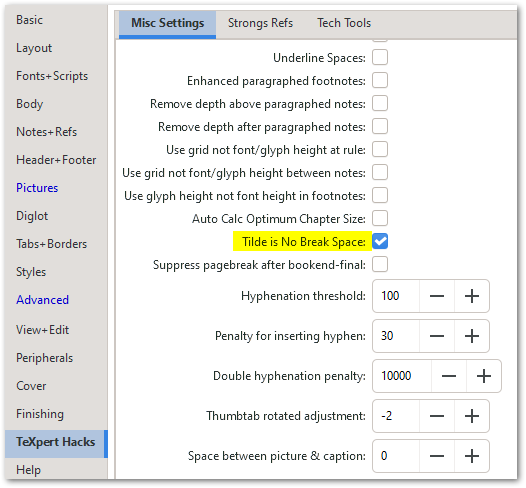
還有另一個複雜之處——如果您嘗試使用 ~ 波浪號但不起作用,請查看 TeXpert Hacks,看看是否啟用了此設定(這應該有助於解決問題):
Yes, there are several ways of doing what you are asking for. First decide whether you want to create a rule that KEEPS elements together (and could therefore be a more generic rule to apply everywhere), or one that forces words to SPLIT APART (tends to be very location specific).
In line 6 (currently commented out with a #) I have shown how you would keep 2 words together using the ~ tilde in order to force them onto the same line.
In your case the simplest rule would look like this:
at GEN 19:0 'i Sodom' > 'i~Sodom'
In line 8 I have shown a rule that encourages the line to break at a certain point using the // instead of a space. Again, this would look like this:
at GEN 19:0 'tou i' > 'tou//i'
Notice that because we're being so specific with the location GEN 19:0 (= the part of chapter 19 which comes BEFORE verse 1) we can use just part of the word (mamantou); and although I usually like the use of (capture) (groups) and "\1//\2" using numbered group replacements, it ends up as more work - hence the simple rule that I suggest above.
Interestingly, sometimes // won't split the line due to calculated penalties etc. and you might need to use a forced Line Separator instead, as seen on line 9. And even more curious is that the regular Line Feed (\u000A) didn't work at all - but I have no idea why. Perhaps someone else can explain that.
There is one other complication - if you are trying to use ~ tilde but it isn't working, have a look at the TeXpert Hacks to see if this setting is enabled (which should help):
機器翻譯自 English








