हाँ, आपकी मांग पूरी करने के कई तरीके हैं। सबसे पहले तय करें कि क्या आप एक नियम बनाना चाहते हैं जो तत्वों को साथ में रखे (जो कि हर जगह लागू करने के लिए एक अधिक सामान्य नियम हो सकता है), या एक ऐसा नियम जो शब्दों को अलग करने के लिए मजबूर करे (जो बहुत ही स्थान-विशिष्ट होता है)।

पंक्ति 6 में (जो वर्तमान में # के साथ टिप्पणी की गई है) मैंने दिखाया है कि आप ~ टिल्ड का उपयोग करके 2 शब्दों को एक ही पंक्ति पर रखने के लिए उन्हें कैसे साथ में रख सकते हैं।
आपके मामले में सबसे सरल नियम इस तरह दिखेगा:
at GEN 19:0 'i Sodom' > 'i~Sodom'
पंक्ति 8 में मैंने एक नियम दिखाया है जो // का उपयोग करके किसी निश्चित बिंदु पर पंक्ति को तोड़ने की प्रेरणा देता है। इसका रूप भी इस तरह होगा:
at GEN 19:0 'tou i' > 'tou//i'
ध्यान दें कि क्योंकि हम स्थान GEN 19:0 (= अध्याय 19 का वह हिस्सा जो श्लोक 1 से पहले आता है) के साथ इतने विशिष्ट हैं, हम शब्द का केवल एक हिस्सा (mamantou) उपयोग कर सकते हैं; और हालाँकि मैं आमतौर पर संख्यांकित समूह प्रतिस्थापन का उपयोग करने वाले (capture) (groups) और "\1//\2" का उपयोग करना पसंद करता हूँ, यह अधिक काम बन जाता है - इसलिए मैंने ऊपर सरल नियम सुझाया है।
रुचिकर बात यह है कि कभी-कभी // पंक्ति को तोड़ता नहीं है, गणना किए गए दंड आदि के कारण, और आपको पंक्ति 9 में देखे गए जैसा एक मजबूरी वाला Line Separator उपयोग करने की आवश्यकता हो सकती है। और और भी अजीब बात यह है कि सामान्य Line Feed (\u000A) बिल्कुल काम नहीं किया - लेकिन मुझे कारण नहीं पता। शायद कोई और इसे समझा सके।
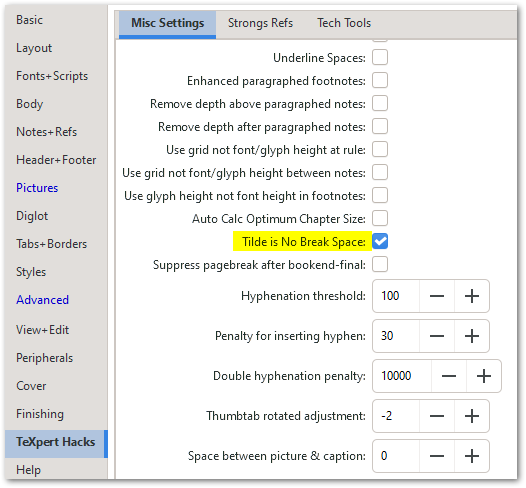
एक और जटिलता है - यदि आप ~ टिल्ड का उपयोग करने की कोशिश कर रहे हैं लेकिन यह काम नहीं कर रहा है, तो देखें कि यह सेटिंग सक्षम है या नहीं (जो मदद करनी चाहिए) TeXpert Hacks में:
Yes, there are several ways of doing what you are asking for. First decide whether you want to create a rule that KEEPS elements together (and could therefore be a more generic rule to apply everywhere), or one that forces words to SPLIT APART (tends to be very location specific).
In line 6 (currently commented out with a #) I have shown how you would keep 2 words together using the ~ tilde in order to force them onto the same line.
In your case the simplest rule would look like this:
at GEN 19:0 'i Sodom' > 'i~Sodom'
In line 8 I have shown a rule that encourages the line to break at a certain point using the // instead of a space. Again, this would look like this:
at GEN 19:0 'tou i' > 'tou//i'
Notice that because we're being so specific with the location GEN 19:0 (= the part of chapter 19 which comes BEFORE verse 1) we can use just part of the word (mamantou); and although I usually like the use of (capture) (groups) and "\1//\2" using numbered group replacements, it ends up as more work - hence the simple rule that I suggest above.
Interestingly, sometimes // won't split the line due to calculated penalties etc. and you might need to use a forced Line Separator instead, as seen on line 9. And even more curious is that the regular Line Feed (\u000A) didn't work at all - but I have no idea why. Perhaps someone else can explain that.
There is one other complication - if you are trying to use ~ tilde but it isn't working, have a look at the TeXpert Hacks to see if this setting is enabled (which should help):
English से मशीन-अनुवादित