Sí, hay varias formas de hacer lo que pides. Primero decide si quieres crear una regla que MANTENGA los elementos juntos (y por lo tanto podría ser una regla más genérica para aplicar en todas partes), o una que fuerce a las palabras a SEPARARSE (tiende a ser muy específica de la ubicación).

En la línea 6 (actualmente comentada con un #) he mostrado cómo mantener 2 palabras juntas usando la tilde ~ para forzarlas a estar en la misma línea.
En tu caso, la regla más simple se vería así:
at GEN 19:0 'i Sodom' > 'i~Sodom'
En la línea 8 he mostrado una regla que anima a la línea a romperse en un punto determinado usando // en lugar de un espacio. Nuevamente, se vería así:
at GEN 19:0 'tou i' > 'tou//i'
Observa que, como estamos siendo muy específicos con la ubicación GEN 19:0 (= la parte del capítulo 19 que viene ANTES del versículo 1), podemos usar solo parte de la palabra (mamantou); y aunque normalmente me gusta el uso de (capture) (grupos) y "\1//\2" usando reemplazos de grupos numerados, termina siendo más trabajo - de ahí la regla simple que sugiero arriba.
Curiosamente, a veces // no divide la línea debido a penalizaciones calculadas, etc., y es posible que necesites usar un separador de línea forzado en su lugar, como se ve en la línea 9. Y aún más curioso es que el salto de línea regular (\u000A) no funcionó en absoluto - pero no tengo idea de por qué. Quizás alguien más pueda explicarlo.
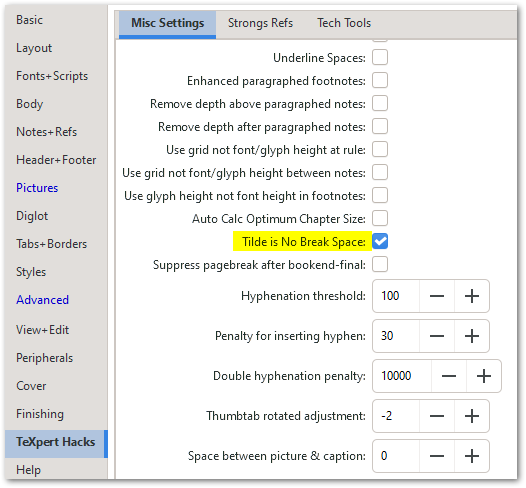
Hay otra complicación - si estás intentando usar la tilde ~ y no funciona, echa un vistazo a TeXpert Hacks para ver si esta configuración está habilitada (lo cual debería ayudar):
Yes, there are several ways of doing what you are asking for. First decide whether you want to create a rule that KEEPS elements together (and could therefore be a more generic rule to apply everywhere), or one that forces words to SPLIT APART (tends to be very location specific).
In line 6 (currently commented out with a #) I have shown how you would keep 2 words together using the ~ tilde in order to force them onto the same line.
In your case the simplest rule would look like this:
at GEN 19:0 'i Sodom' > 'i~Sodom'
In line 8 I have shown a rule that encourages the line to break at a certain point using the // instead of a space. Again, this would look like this:
at GEN 19:0 'tou i' > 'tou//i'
Notice that because we're being so specific with the location GEN 19:0 (= the part of chapter 19 which comes BEFORE verse 1) we can use just part of the word (mamantou); and although I usually like the use of (capture) (groups) and "\1//\2" using numbered group replacements, it ends up as more work - hence the simple rule that I suggest above.
Interestingly, sometimes // won't split the line due to calculated penalties etc. and you might need to use a forced Line Separator instead, as seen on line 9. And even more curious is that the regular Line Feed (\u000A) didn't work at all - but I have no idea why. Perhaps someone else can explain that.
There is one other complication - if you are trying to use ~ tilde but it isn't working, have a look at the TeXpert Hacks to see if this setting is enabled (which should help):