Sim, há várias maneiras de fazer o que você está pedindo. Primeiro, decida se você quer criar uma regra que MANTÉM os elementos juntos (e portanto poderia ser uma regra mais genérica para aplicar em qualquer lugar), ou uma que força as palavras a SEPARAR (tende a ser muito específica para um local).

Na linha 6 (atualmente comentada com um #), mostrei como manter 2 palavras juntas usando o ~ til para forçá-las a ficar na mesma linha.
No seu caso, a regra mais simples seria assim:
at GEN 19:0 'i Sodom' > 'i~Sodom'
Na linha 8, mostrei uma regra que incentiva a quebra da linha em um determinado ponto usando // em vez de um espaço. Novamente, isso seria assim:
at GEN 19:0 'tou i' > 'tou//i'
Observe que, como estamos sendo muito específicos com o local GEN 19:0 (= a parte do capítulo 19 que vem ANTES do versículo 1), podemos usar apenas parte da palavra (mamantou); e, embora eu geralmente prefira o uso de (capture) (grupos) e "\1//\2" usando substituições de grupo numeradas, acaba sendo mais trabalho - por isso a regra simples que sugiro acima.
Curiosamente, às vezes // não divide a linha devido a penalidades calculadas, etc., e você pode precisar usar um Separador de Linha forçado, como visto na linha 9. E ainda mais curioso é que o Line Feed (\u000A) não funcionou de jeito nenhum - mas não tenho ideia do porquê. Talvez outra pessoa possa explicar isso.
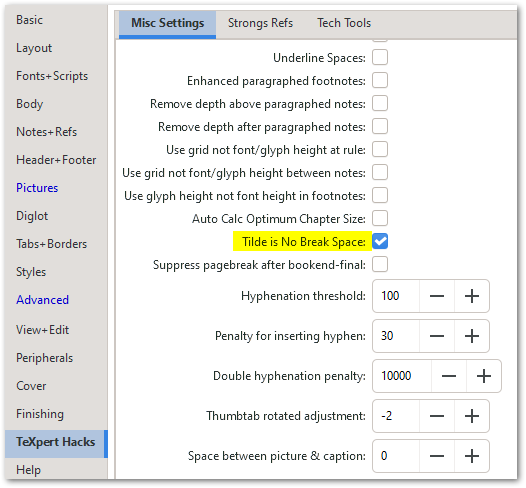
Há outra complicação - se você está tentando usar o ~ til e não está funcionando, dê uma olhada nos TeXpert Hacks para ver se essa configuração está habilitada (o que deve ajudar):
Yes, there are several ways of doing what you are asking for. First decide whether you want to create a rule that KEEPS elements together (and could therefore be a more generic rule to apply everywhere), or one that forces words to SPLIT APART (tends to be very location specific).
In line 6 (currently commented out with a #) I have shown how you would keep 2 words together using the ~ tilde in order to force them onto the same line.
In your case the simplest rule would look like this:
at GEN 19:0 'i Sodom' > 'i~Sodom'
In line 8 I have shown a rule that encourages the line to break at a certain point using the // instead of a space. Again, this would look like this:
at GEN 19:0 'tou i' > 'tou//i'
Notice that because we're being so specific with the location GEN 19:0 (= the part of chapter 19 which comes BEFORE verse 1) we can use just part of the word (mamantou); and although I usually like the use of (capture) (groups) and "\1//\2" using numbered group replacements, it ends up as more work - hence the simple rule that I suggest above.
Interestingly, sometimes // won't split the line due to calculated penalties etc. and you might need to use a forced Line Separator instead, as seen on line 9. And even more curious is that the regular Line Feed (\u000A) didn't work at all - but I have no idea why. Perhaps someone else can explain that.
There is one other complication - if you are trying to use ~ tilde but it isn't working, have a look at the TeXpert Hacks to see if this setting is enabled (which should help):








