Saludos Paula.
Ao testar, vejo que a verificação de referências levará em conta tanto o “\x” quanto o “\f”.
Você pode não querer ver o “\f”, mas o resultado permite notar facilmente a diferença entre um e o outro.
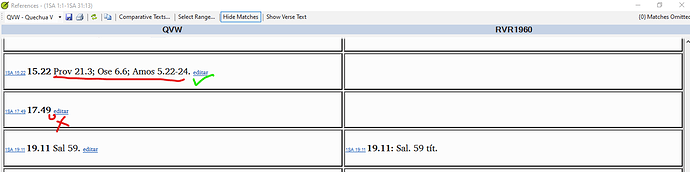
image1432×358 17.2 KB
Como a imagem mostra. À esquerda, tenho um projeto de tradução e, à direita, um recurso de comparação.
À esquerda, se houver uma referência cruzada, você verá a citação bíblica (15.22) seguida pela citação paralela referenciada.
Ao contrário da segunda citação (17.49), que não é seguida por nenhuma citação, pois corresponde a uma nota de rodapé.
Portanto, é muito rápido notar quais desses resultados são referências cruzadas que não correspondem ao seu texto de comparação.
Se você também usar a opção “Hide Matches”, reduzirá o número de linhas que precisa verificar.
Espero que isso seja útil,
anon689242.
Saludos Paula.
By testing I see that the reference check will take both the “\x” and the “\f”.
You might not want to see the “\f” but the result lets you easily notice the difference between one and the other.
image1432×358 17.2 KB
As the image shows. On the left I have a translation project and on the right a comparison resource.
On the left, if there is a cross-reference you will see the biblical quotation (15.22) followed by the referenced parallel quotation.
Unlike the second quotation (17.49) where it is not followed by any quotation, because it corresponds to a footnote.
So it is very quick to notice which of these results are cross-references that do not match your comparison text.
If you also use the “Hide Matches” option, you will reduce the number of lines you have to cross-reference.
I hope this is useful,
anon689242.








