Je suis intéressé par ce que les autres disent à propos de ce que je considère comme un défaut dans la gestion des notes par Paratext. J'ai envoyé ma contribution sous forme de rapport de bug et de suggestion d'amélioration, mais je n'obtiens pas d'écho. On me dit que le programme fait ce pour quoi il a été conçu. C'est très bien, mais mon point est que cette conception n'est pas utile pour les utilisateurs.
Lorsqu'une note est attachée à un mot, et que ce mot est ensuite supprimé ou remplacé par un autre mot, la note perd son ancrage et est déplacée vers une autre occurrence du même mot, ou, si un tel mot n'est pas trouvé, vers le début du verset. Je ne vois aucune justification à ce comportement. Quelqu'un voit-il cela comme une bonne façon de faire ?
Ce n'est pas trop grave lorsque je travaille dans un livre de la Bible avec des versets, mais si je suis dans un livre supplémentaire comme XXA où j'ai six Easy Readers basés sur la Bible, il n'y a pas de versets. J'ai donné à chaque histoire son propre chapitre et ajouté des numéros de versets pour chaque section/paragraphe. Ces versets ne sont ajoutés que pour atténuer le comportement erratique des notes flottantes et devront être supprimés plus tard.
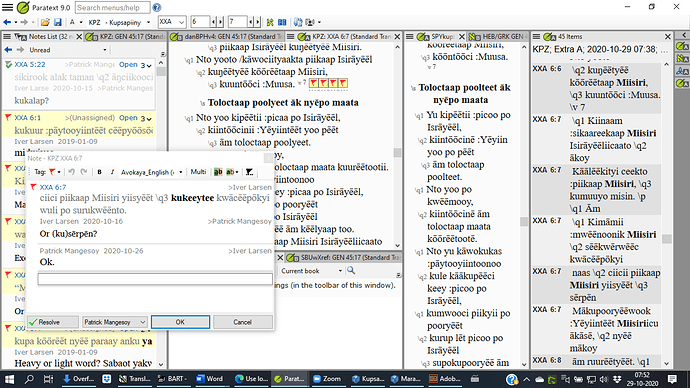
S'il y a beaucoup de notes, je peux voir une douzaine de notes d'affilée au numéro du verset et il est très difficile de comprendre d'où elles viennent. Je dois généralement prendre un mot du contexte sauvegardé dans la note, effectuer une recherche, trouver le bon contexte et double-cliquer sur ce résultat. J'essaierai de joindre une capture d'écran pour illustrer cela.
Maintenant, le problème pourrait être facilement résolu si le programme était modifié pour attacher la note au mot précédent au lieu des deux options actuelles. De cette façon, la note est liée à son contexte et il serait facile de manipuler la note. Si je le souhaitais, je pourrais également facilement la rattacher au nouveau mot, au cas où je ne serais pas satisfait de ce nouveau mot.
2020-10-291280×720 180 KB
I am interested in what others say about what I consider a flaw in the Paratext handling of notes.I have sent my contribution as a bug report and suggestion for improvement, but I am not getting a hearing. I am told that the program does what it is designed to do That is fine, but my point is that this design is unhelpful for the users.
When a note is attached to a word, and that word is then deleted or substituted with another word, the note loses its anchor and is moved to another instance of the same word or if such a word is not found, then to the beginning of the verse. I see no rationale for this behavior. Does anyone see this as a good way to do it?
It is not too bad when I am working in a Bible book with verses, but if I am in an extra book like XXA where I have six Easy Readers based on the Bible, there are no verses. I have given each story its own chapter and added verse numbers for each section/paragraph. Those verses are only added in order to alleviate the erratic behaviour of the floating notes and will have to be removed later.
If there are many notes, I may see a dozen notes in a row at the verse number and it is very difficult to figure out where they came from. I usually have to take a word from the context saved inside the note, do a search, find the correct context and double click on that hit. I shall try to attach a screen shot to illustrate this.
Now, the problem could be solved easily, if the program was changed to attach the note to the preceding word instead of the current two options. In this way, the note is tied to its context and it would be easy to handle the note. If I wanted to, I could also easily re-attach it to the new word, in case I was not satisfied with that new word.
2020-10-291280×720 180 KB
Traduit automatiquement depuis English