Me interesa saber qué opinan los demás sobre lo que considero un defecto en la forma en que Paratext maneja las notas. He enviado mi contribución como informe de error y sugerencia de mejora, pero no estoy obteniendo respuesta. Me dicen que el programa hace lo que está diseñado para hacer. Eso está bien, pero mi punto es que este diseño no es útil para los usuarios.
Cuando una nota está unida a una palabra y esa palabra se elimina o se sustituye por otra, la nota pierde su ancla y se mueve a otra instancia de la misma palabra o, si no se encuentra tal palabra, al principio del versículo. No veo ninguna razón para este comportamiento. ¿Alguien ve esto como una buena forma de hacerlo?
No es tan grave cuando trabajo en un libro de la Biblia con versículos, pero si estoy en un libro adicional como XXA, donde tengo seis Easy Readers basados en la Biblia, no hay versículos. He asignado a cada historia su propio capítulo y he añadido números de versículo para cada sección/párrafo. Esos versículos solo se añaden para aliviar el comportamiento errático de las notas flotantes y tendrán que eliminarse más adelante.
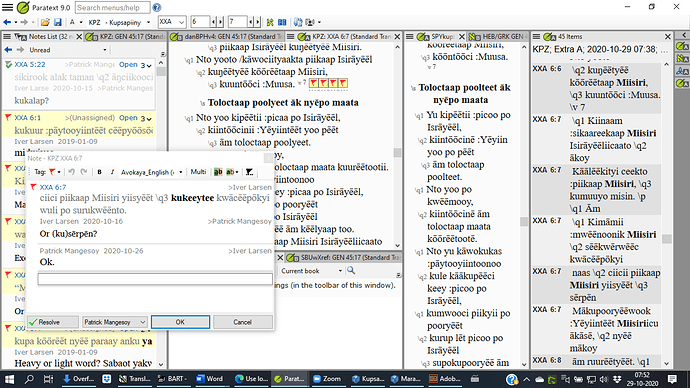
Si hay muchas notas, puedo ver una docena de notas seguidas en el número del versículo y es muy difícil averiguar de dónde provienen. Normalmente tengo que tomar una palabra del contexto guardado dentro de la nota, hacer una búsqueda, encontrar el contexto correcto y hacer doble clic en ese resultado. Intentaré adjuntar una captura de pantalla para ilustrar esto.
Ahora bien, el problema podría resolverse fácilmente si el programa se cambiara para unir la nota a la palabra anterior en lugar de las dos opciones actuales. De esta manera, la nota estaría ligada a su contexto y sería fácil de manejar. Si quisiera, también podría volver a unirla fácilmente a la nueva palabra, en caso de que no estuviera satisfecho con esa nueva palabra.
2020-10-291280×720 180 KB
I am interested in what others say about what I consider a flaw in the Paratext handling of notes.I have sent my contribution as a bug report and suggestion for improvement, but I am not getting a hearing. I am told that the program does what it is designed to do That is fine, but my point is that this design is unhelpful for the users.
When a note is attached to a word, and that word is then deleted or substituted with another word, the note loses its anchor and is moved to another instance of the same word or if such a word is not found, then to the beginning of the verse. I see no rationale for this behavior. Does anyone see this as a good way to do it?
It is not too bad when I am working in a Bible book with verses, but if I am in an extra book like XXA where I have six Easy Readers based on the Bible, there are no verses. I have given each story its own chapter and added verse numbers for each section/paragraph. Those verses are only added in order to alleviate the erratic behaviour of the floating notes and will have to be removed later.
If there are many notes, I may see a dozen notes in a row at the verse number and it is very difficult to figure out where they came from. I usually have to take a word from the context saved inside the note, do a search, find the correct context and double click on that hit. I shall try to attach a screen shot to illustrate this.
Now, the problem could be solved easily, if the program was changed to attach the note to the preceding word instead of the current two options. In this way, the note is tied to its context and it would be easy to handle the note. If I wanted to, I could also easily re-attach it to the new word, in case I was not satisfied with that new word.
2020-10-291280×720 180 KB
Traducción automática desde English








