As categorias lexicais são usadas para agrupar palavras. O agrupamento pode ser muito amplo, como verbos, ou muito específico, como pronomes com sufixos femininos. As categorias são usadas no sistema de correspondência de padrões das regras de transferência.
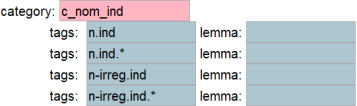
A imagem acima é um exemplo de uma categoria lexical para nominais indefinidos. O ponto indica onde uma nova tag começa. O asterisco é um indicador de curinga. Significa que qualquer coisa pode preencher aquela posição. Um asterisco no final do item corresponde a uma ou mais tags finais. Por exemplo, se eu tiver a unidade lexical book1.1 n f sg, ela poderia ser correspondida precisamente por um elemento de tags contendo n.f.sg. De forma mais geral, poderíamos corresponder book com o elemento de tags contendo n.f.*. Isso se referiria a todas as palavras que têm a categoria gramatical n seguida pela tag f e depois por qualquer outra coisa, ou seja, substantivos femininos. A categoria acima define o conjunto de todos os substantivos indefinidos — palavras que têm a categoria gramatical n ou n-irreg seguida por ind e, opcionalmente, por outra coisa depois. Observe que n.ind e n.ind.* são ambos necessários, pois n.ind.* exigiria algum afixo após ind e não corresponderia a um substantivo indefinido como car1.1 n ind que não tem sufixos adicionais.
Você pode usar o elemento lema para identificar um sentido de palavra específico. A imagem abaixo mostra como a categoria dem_this pode ser definida como uma palavra que tem uma categoria gramatical de dem e lema this1.1 (no FLEx: palavra principal this1, sentido 1). Isso pode ser útil quando você deseja corresponder frases que contenham a palavra ‘this’.
Lexical categories are used to group words together. The grouping can be very broad such as verbs or very specific such as pronouns with feminine suffixes. The categories are used in the pattern matching system of transfer rules.
The above image is an example of a lexical category for indefinite nominals. The period indicates where a new tag begins. The asterisk is a wildcard indicator. It means that anything can fill that position. An asterisk at the end of the item matches one or more final tags. For example, if I have the lexical unit book1.1 n f sg, it could be precisely matched by a tags element containing n.f.sg. More generally we could match book with the tags element containing n.f.*. This would refer to all words that have the grammatical category n followed by the tag f followed by anything else, i.e. feminine nouns. The category above defines the set of all indefinite nouns — words that have the grammatical category n or n-irreg followed by ind and optionally something else afterward. Note that n.ind and n.ind.* are both necessary because n.ind.* would require some affix after ind and not match an indefinite noun like car1.1 n ind that has no additional suffixes.
You can use the lemma element to identify a specific word-sense. The image below shows how the category dem_this can be defined as a word that has a grammatical category of dem and lemma this1.1 (in FLEx: headword this1 , sense 1). This might be useful when you want to match phrases containing the word ‘this’.