Kategori leksikal digunakan untuk mengelompokkan kata-kata. Pengelompokan ini bisa sangat luas, seperti kata kerja, atau sangat spesifik, seperti kata ganti dengan sufiks feminin. Kategori-kategori ini digunakan dalam sistem pencocokan pola (pattern matching) dari aturan transfer.
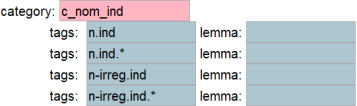
Gambar di atas adalah contoh kategori leksikal untuk nominal tak tentu (indefinite nominals). Titik menunjukkan di mana tag baru dimulai. Bintang (*) adalah penanda wildcard. Artinya, apa pun dapat mengisi posisi tersebut. Bintang di akhir item mencocokkan satu atau lebih tag akhir. Misalnya, jika saya memiliki unit leksikal book1.1 n f sg, itu dapat dicocokkan secara tepat oleh elemen tags yang berisi n.f.sg. Secara lebih umum, kita dapat mencocokkan book dengan elemen tags yang berisi n.f.*. Ini merujuk pada semua kata yang memiliki kategori gramatikal n diikuti oleh tag f dan diikuti oleh apa pun, yaitu kata benda feminin. Kategori di atas mendefinisikan himpunan semua kata benda tak tentu (indefinite nouns) — kata-kata yang memiliki kategori gramatikal n atau n-irreg diikuti oleh ind dan opsional diikuti oleh sesuatu yang lain. Perhatikan bahwa n.ind dan n.ind.* keduanya diperlukan karena n.ind.* akan membutuhkan afiks setelah ind dan tidak akan mencocokkan kata benda tak tentu seperti car1.1 n ind yang tidak memiliki sufiks tambahan.
Anda dapat menggunakan elemen lemma untuk mengidentifikasi makna kata (word-sense) tertentu. Gambar di bawah menunjukkan bagaimana kategori dem_this dapat didefinisikan sebagai kata yang memiliki kategori gramatikal dem dan lemma this1.1 (di FLEx: headword this1, sense 1). Ini mungkin berguna ketika Anda ingin mencocokkan frasa yang mengandung kata ‘this’.
Lexical categories are used to group words together. The grouping can be very broad such as verbs or very specific such as pronouns with feminine suffixes. The categories are used in the pattern matching system of transfer rules.
The above image is an example of a lexical category for indefinite nominals. The period indicates where a new tag begins. The asterisk is a wildcard indicator. It means that anything can fill that position. An asterisk at the end of the item matches one or more final tags. For example, if I have the lexical unit book1.1 n f sg, it could be precisely matched by a tags element containing n.f.sg. More generally we could match book with the tags element containing n.f.*. This would refer to all words that have the grammatical category n followed by the tag f followed by anything else, i.e. feminine nouns. The category above defines the set of all indefinite nouns — words that have the grammatical category n or n-irreg followed by ind and optionally something else afterward. Note that n.ind and n.ind.* are both necessary because n.ind.* would require some affix after ind and not match an indefinite noun like car1.1 n ind that has no additional suffixes.
You can use the lemma element to identify a specific word-sense. The image below shows how the category dem_this can be defined as a word that has a grammatical category of dem and lemma this1.1 (in FLEx: headword this1 , sense 1). This might be useful when you want to match phrases containing the word ‘this’.
Diterjemahkan secara otomatis dari English








