0
424 次浏览

I have an Arabic script project which has 3 levels of quotes:
« ‹ “ ” › »
These have the following Unicode code points:
\u00AB \u2039 \u201C \u201D \u203A \u00BB

The top two levels reverse themselves automatically in my RTL project in Paratext. So for example, I use \u00AB to open a quote, but it looks like this on the screen: ». This is generally normal behavior in RTL, and I’m fine with that.

But the third level quotes are not reversing in the same way. In order to get this in Paratext:
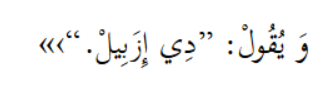
image
I need to use \u201D on the right (the “opening” quote) and \u201C on the left (the “closing” quote).

It is true that in the Unicode standard U+201C is LEFT DOUBLE QUOTATION MARK, and U+201D is RIGHT, etc. But the guillemets are defined in the same way (using RIGHT- and LEFT-POINTING), but they reverse.

However, it appears that my XeTeX publishing process DOES reverse them, so if they appear properly in Paratext, they get reversed in the PDF output. That’s not a problem - I have a processing step in between them, and I can swap the characters if I need to.

BUT MY QUESTION is what is the CORRECT form to have in Paratext? The Scripture text data will be used in YouVersion and elsewhere, and it would be helpful if those quotes are turned around the right way in those outputs as well. Should I assume that if it appears correctly in Paratext, that it will appear correctly in YouVersion? Or should I use U+201C as the opening quote, even though it doesn’t appear properly in Paratext, because down-the-road outputs will do the right thing?


较早的帖子 - 以原始语言显示
Paratext (1.4k 分) 发布
已重新显示 | 424 次浏览

5 个回答

0
最佳答案

If you look at the details of those Unicode characters, you can see that \u00AB, \u2039, \u203A, \u00BB all have the ability to “mirror” while \u201C and \u201D do not. Because all of them are also marked as BIDI-neutral (meaning they can appear in RTL or LTR text), this causes them to appear in RTL order, but the glyphs do not get mirrored (causing what you are seeing).

I think it is actually XeTeX that is wrong.

较早的帖子 - 以原始语言显示
[Expert]
(16.7k 分) 发布
0

Interestingly enough, using Times New Roman font in LibreOffice Writer, with these quotes:
image
if I turn it into a RTL paragraph, it of course jumps to the right side of the page, but this is what I get for the quotes:
image
So does that mean that U+201C and U+201D are not intended to automatically swap like other quote pairs? That I should just use the desired surface form?

But that doesn’t align with what I saw in XeTeX, where it did actually reverse the surface forms I had put into Paratext, and made them backwards.

Some more food for thought…

较早的帖子 - 以原始语言显示
(1.4k 分) 发布
0

OK, so you are saying that from a data perspective, if we use those characters for quotes, you think we should use U+201D to open and U+201C to close these RTL quotes, correct? That certainly makes them appear correctly in Paratext. Do you think that YouVersion and other folks that might eventually use this text data will also make them appear correctly in their outputs?

Even if XeTeX is wrong in the way it handles these characters, I can easily pre-process my texts to modify the them and make the typesetting come out the right way. So there is no problem there. But I wanted to make sure that the text data that goes into the DBL from Paratext is as “correct” as possible.

较早的帖子 - 以原始语言显示
(1.4k 分) 发布
0

Just a question of curiosity: How many times do you get to a third level of quotes? (Of course, it doesn’t matter to the solution whether it’s 1 or 1000.)

较早的帖子 - 以原始语言显示
(296 分) 发布

We got to third level quotes about 200 times in the entire Bible. The main culprits are Jeremiah and Ezekiel (127 times), where I heard that the team had to be creative to avoid 4th level quotes… (Check out the he said, you said of JER 45:2-3)

较早的帖子 - 以原始语言显示
0

(Sheepish reply) OK, so XeTeX isn’t handling the quotes incorrectly. It turns out that in my XeTeX setup file I have code (written a while back that I forgot was in there) that swaps the left and right quotes. So I’m pretty sure that if fix up the XeTeX setup file, I should be all set.

I think, however, that it was still useful to have has this discussion, as it has made some things more clear in my mind. Thanks.

较早的帖子 - 以原始语言显示
(1.4k 分) 发布

相关问题

0
1 个回答 227 次浏览
我正在为一种基于阿拉伯字母的正字法创建 PDF 我使用数字映射将 PT 输出的拉丁数字转换为阿拉伯数字 圣经文本中包含 4 位或更多数字的大数字,通常使用拉丁字母书写,并以点号作为千位分隔符 因此,120000 写作 120.000 ... 前;我需要在拉丁文和阿拉伯文输出中都使用惯用的点号 所以我的问题是,有没有办法在 PTXprint 中修正这个问题?
Kirk 123 发布 提问于 八月 28, 2024
0
2 个回答 255 次浏览
I'm having a problem with quotation rules where when there is an OT quote embedded in someone's speech. The following is ... to implement that I still couldn't get things to work.
fhardison8588 111 发布 提问于 一月 26, 2022
0
5 个回答 579 次浏览
我们在脚注中使用单引号来表示单词的含义 例如: ... \ft "Messiah" in Hebrew means 'Anointed One'. \f* 当我们运行引号检查(Quotation check)时,它将 ... within Quotes ' Quotes Continuer required at: p p/q1 b/q1
anon469793 155 发布 提问于 一月 29, 2020
0
3 个回答 356 次浏览
Please advise what is the best way in Paratext 7.6 to check Old Testament quotes that occur more than once. I ... this is a necessary part of final checking a New Testament.
muckles 540 发布 提问于 六月 5, 2015
+1
2 个回答 246 次浏览
你好, 我正在协助一个阿拉伯语项目,一位审阅者想知道是否有人遇到过搜索单词时的这个问题: 当我处理阿拉伯语单词时,例如查找拼写相同的单词列表,它无法产生任何有用的结果,并且几乎遗漏了 99% 的相关搜索词,因为它严格匹配(字 ... 价值的搜索工具对阿拉伯语用户有用 Paratext 中是否已经有这样的单词搜索方式,我可以告知他? 感谢任何回复,谢谢!
anon835123 121 发布 提问于 一月 19, 2023
Welcome to Support Bible, where you can ask questions and receive answers from other members of the community.
But if we walk in the light, as he is in the light, we have fellowship with one another, and the blood of Jesus, his Son, purifies us from all sin.
1 John 1:7
3,046 个问题
6,005 个回答
5,671 条评论
2,026 位用户