不要全信「支援代理」(Support Agent)說的話 :-) 當它不知道正確答案時,幻覺(Hallucination)是它的預設行為!所以請移除你嘗試建立的 ptxprint-PSA.sty 檔案。那完全沒有幫助。
我不確定你目前的《詩篇》是用哪些標記(markers)標註的,但通常詩歌會使用 \q1 和 \q2。因此,如果你希望《詩篇》中的詩歌置中,請基於現有的 \q1 和 \q2 新增樣式(即新增一兩個標記),但限制它們僅適用於 PSA,如下所示:
id:PSA|q1
id:PSA|q2
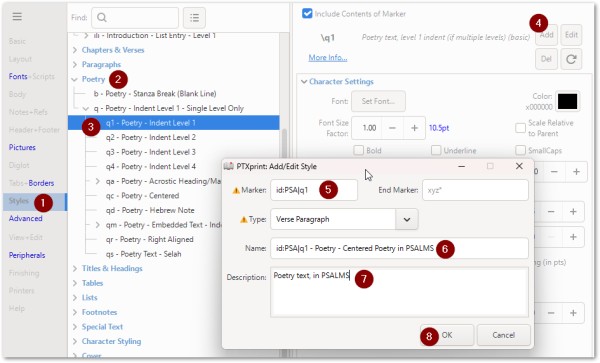
然後,一旦新增了新的樣式(限制僅適用於 PSA),你就可以如圖所示修改其參數:
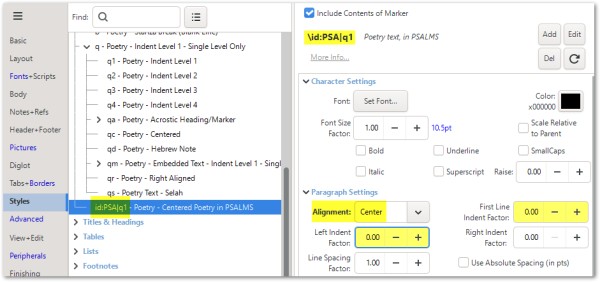
技術參考手冊(Technical Reference Manual)第 14 頁有更多關於樣式命名的說明(請參閱「說明」分頁)。
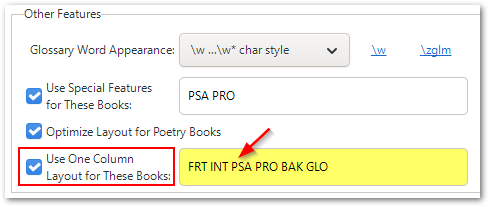
請注意,要在雙欄出版物中為 PSA 實現單欄版面,你需要在「內文」(Body)分頁、靠近螢幕底部的位置進行設定。
Don't believe everything the Support Agent tells you :-) Hallucination is its default action when it doesn't know the right answer! So please remove the ptxprint-PSA.sty file that you tried. That will not help at all.
I'm not sure what markers your Psalms are currently marked up with, but usually it is \q1 and \q2 for poetry. So if you wanted poetry within the Psalms to be centered, then Add the style(s) (i.e. a new marker or two) based on the existing \q1 and \q2, but limit them to only apply to PSA as shown below:
id:PSA|q1
id:PSA|q2
Then once the NEW style has been added (restricted to work with PSA) you can change it's parameters as shown here:
There is more help on naming of Styles on Pg14 of the technical reference manual (see Help tab).
Note that to get ONE-column layout for PSA in a TWO-column publication, you will need to set this on the Body tab, near the bottom of the screen.
機器翻譯自 English








