Qual é a melhor maneira de lidar com traduções de verbo para frase verbal? Em Mato (língua-fonte), temos harungia 'falar contra', que é renderizado como pasila suki mana 'falar escorregar sobre' em Uma (língua-alvo). O verbo da fonte pode ter tanto um sujeito quanto um objeto. A frase verbal da língua-alvo requer um prefixo de sujeito (no verbo, que é a primeira palavra da frase), mas não tolera um sufixo de objeto: da-harungia-di '3p.S-falar contra-3p.O / eles falam contra eles' > di-pasila suki mana '3p.S-falar escorregar sobre'. Posso remover o objeto com uma regra. Mas para sintetizar a palavra-alvo, preciso fazer o seguinte no léxico-alvo: 1. Definir um modelo para frases verbais, 2. Preencher o slot do sujeito com os prefixos de sujeito e, em seguida, 3. Redefinir os glosses para os glosses da frase verbal para algo como 3p.S2, o que me levaria de volta a escrever uma regra para lidar com todos os glosses alternativos (3p.S>3p.S2, etc.) para sintetizar dentro do banco de dados-alvo. Foi no ponto 3 que isso ficou realmente trabalhoso, e estou me perguntando se há uma solução mais fácil?
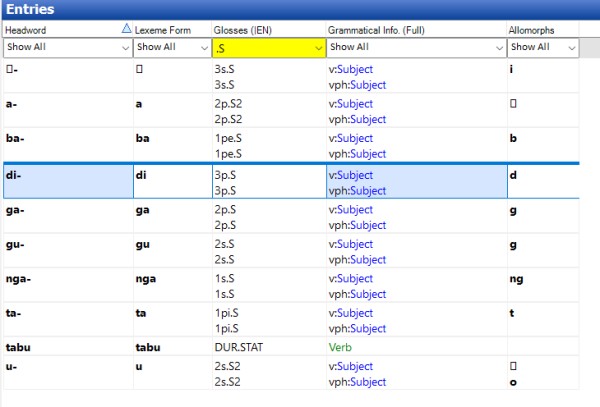
What's the best way to handle verb to verb phrase translations? In Mato (source lg) we have harungia 'speak against' which is rendered as pasila suki mana 'speak slip about' in Uma (target lg). The source verb can take both a subject and an object. The target language verb phrase requires a subject prefix (on the verb which is the first word in the phrase), but will not tolerate an object suffix: da-harungia-di '3p.S-speak against-3p.O / they speak them against' > di-pasila suki mana '3p.S-speak slip about'. I can strip the object with a rule. But to synthesize the target word means that I need to do the following in the target lexicon: 1. Define a template for verb phrases, 2. Populate the subject slot with the subject prefixes, then 3. Redefine the glosses for the verb phrase glosses to something like 3p.S2, which would then send me back to writing a rule to handle all the alternate glosses (3p.S>3p.S2, etc) for synthesizing within the target database. It was at point 3 that this became really cumbersome, and I'm wondering if there's an easier solution?