0 votes
14 views

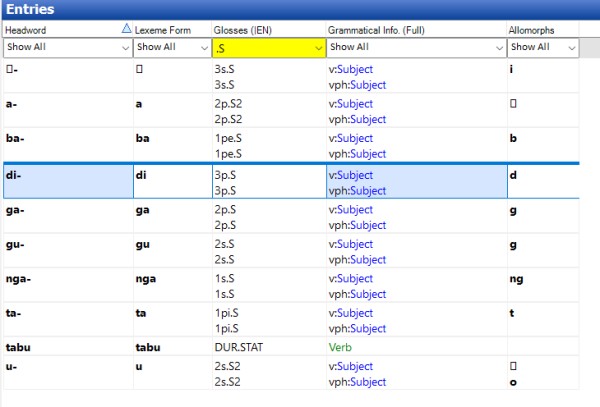
What's the best way to handle verb to verb phrase translations? In Mato (source lg) we have harungia 'speak against' which is rendered as pasila suki mana 'speak slip about' in Uma (target lg). The source verb can take both a subject and an object. The target language verb phrase requires a subject prefix (on the verb which is the first word in the phrase), but will not tolerate an object suffix: da-harungia-di '3p.S-speak against-3p.O / they speak them against'   >  di-pasila suki mana '3p.S-speak slip about'. I can strip the object with a rule. But to synthesize the target word means that I need to do the following in the target lexicon: 1. Define a template for verb phrases, 2. Populate the subject slot with the subject prefixes, then 3. Redefine the glosses for the verb phrase glosses to something like 3p.S2, which would then send me back to writing a rule to handle all the alternate glosses (3p.S>3p.S2, etc) for synthesizing within the target database. It was at point 3 that this became really cumbersome, and I'm wondering if there's an easier solution?

FLExTrans by (122 points)
reshown by [Administrator]
| 14 views

1 Answer

0 votes

Hi matoxltr,

FLExTrans has good support for phrasal verbs. See How do I deal with phrasal verbs using FLExTrans? l in the documentation. Or if you like try the new chatbot on the FLExTrans website. I used the prompt "How do I deal with a source verb that maps to a phrasal verb in the target?" Let me know if you have questions following the steps.

by (336 points)
Thank you. The part I was missing was to set the complex form type to PHRASAL VERB.

Related questions

0 votes
1 answer 17 views
I've been away from FLExTrans for a few months while I did text analysis on the target lg. In the process, I redefined ... namux-na-ta=di what reason-3s.POSS-QUES=PL 'what reasons'
matoxltr 122 asked Mar 4
0 votes
1 answer 16 views
How do I trap for punctuation when splitting words from the source to the target lg? In the following screenshot du-wa-uyu '3p ... to come out after the two words: Here's my rule:
matoxltr 122 asked Sep 5, 2025
0 votes
0 answers 13 views
In the source language Mato, Proper Nouns take an associative suffix -am in the same way any other noun does: However, ... this work? Is there a different way to approach this?
matoxltr 122 asked Jul 22, 2025
0 votes
2 answers 29 views
In the source language, I have a phrasal verb wasa mana 'tend to/care for'. This is essentially a verb 'watch' and ... , while the mana sythesizes just fine. What is going on here?
matoxltr 122 asked Sep 18, 2025
0 votes
1 answer 119 views
I realised this morning that it is possible to generate tags using literal strings. It is, however, a bit of a ... tags. What are your thoughts on this approach? Cheers, bruce
Bruce_Cox 102 asked Aug 29, 2022
Welcome to Support Bible, where you can ask questions and receive answers from other members of the community.
May the God who gives endurance and encouragement give you the same attitude of mind toward each other that Christ Jesus had.
Romans 15:5
3,037 questions
5,995 answers
5,662 comments
2,022 users





