0
482 次浏览

Sorry if this is rather simple to many of you.

I noticed that users have very helpful tools in the Source Language window: right-click and you get quick access to ressources for:

  • animals
  • plants
  • man made objects

Now people are at least as important as animals, and sadly I cannot find the equivalent tool.

I am aware about Categories and Semantic Domains and filters in the Biblical Terms window (for projects which have opted for “Major Biblical Terms”. I can pull those for profound research, and it means changing several settings and making it all fit the screen.

Daily team work often brings up questions about certain people, often with similar-sounding names. What about Φίλιππος in LUK 3:1, can / must we spell that name like the Φίλιππος in LUK 6:14?

I believe there are ressources already, where friendly experts have spent a lot of work, listing Biblical people/persons*. I further believe that such tools might already be present in PT8 - and we do not want to miss out on those.

Of course I can do several work-arounds. Like do a word-search in Source Language Tool via right-click and “Lemma to search list”. This will not be able to jump the chasm between Greek and Hebrew. We appreciate the search-tools in PT8, but those are in another leage from a right-click and getting an edited ressource.

Often we find a need to harmonize NT-references of OT-characters. We want to know more about the OT-person and (number of) occurrences, references etc.

This is not a feature request, just asking where such goodness might be hiding.

Thank you.

* (I am intrigued by the two entries in Semantic Domains “people” versus “persons” and would as not-native-speaker not know what to tick.)

较早的帖子 - 以原始语言显示
Paratext (934 分) 发布 | 482 次浏览

3 个回答

+2
最佳答案

You mentioned wanting to “jump the chasm between Greek and Hebrew.” I don’t believe there is currently anything that ships with Paratext which already does this, since the standard Biblical Term lists are all keyed off of either the underlying Hebrew lemma OR Greek lemma. I have been wondering whether chasm-jumping would be important to teams, so your comment here is interesting to me.

I’m not sure what’s feasible, but perhaps we could link a Greek term to its corresponding Hebrew term, yet allow the user to easily de-link it. If you or anyone else on this list considers a feature like that to be highly desirable, do feel free to submit a feature request via the Help menu.

Does anyone here know if there are any ready-made lists out there which already do this?
I’m not aware of any such list of terms, but it IS possible to manually create a custom term which will be expected/found in any verses you choose to include. To do this, make sure the Biblical Terms tool is set to your project’s list of terms, then:

  1. Optionally, filter the list via the gloss (“David” in my example here).
  2. Use Edit > Edit Term to inspect both the Hebrew and Greek terms, copying any useful data into a Notepad. The critical data is the list of verse references.
  3. Use Edit > Add Term to create a custom term, then paste the data into it. Screenshot below.

Or, instead of step 3, it’s also possible to carefully copy the verse references from the Hebrew term into the Greek term, or vice versa. Perhaps someone on this list can tell us whether or not customizing the “official” terms is a good idea.
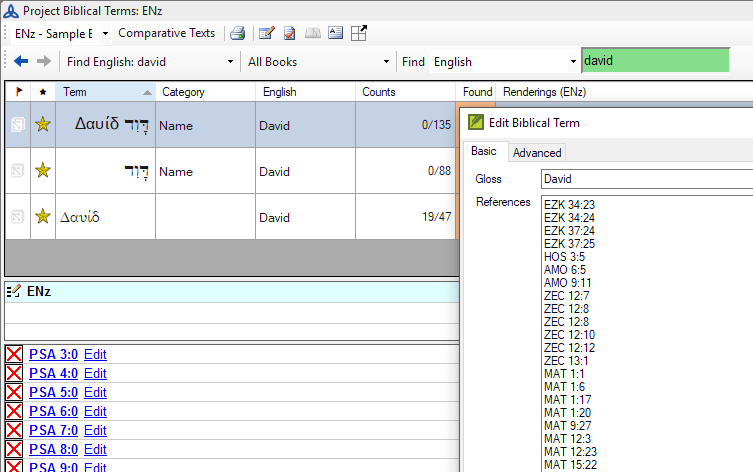
If you’re creating a custom term from scratch (i.e. not copy/pasting from existing terms), I believe the best practice in Paratext 8.0 is to (1) do so via a Lemma search from the SLT. In Paratext 8.1, it will also be possible to (2) do a lemma or sense search without having to deal with the SLT. I’m not speaking from real-life experience with either approach, so I’m not sure what pros/cons/gotchas there might be to each, but here’s an overview.

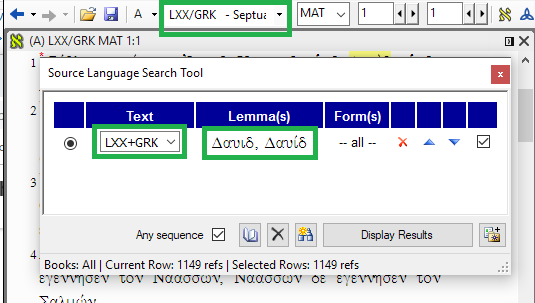
(1) In SLT, you can search either the default HEB or GRK text, or the alternative LXX or BYZ texts. I’m not sure how much time it would actually save here, but if you set your text to LXX/GRK and search for all relevant lemmas, it’s actually possible to get search results across Testaments with a single search. You can then review your search results and choose “Add to Project Biblical Terms” from the Edit menu, if you want to create a custom term.
image

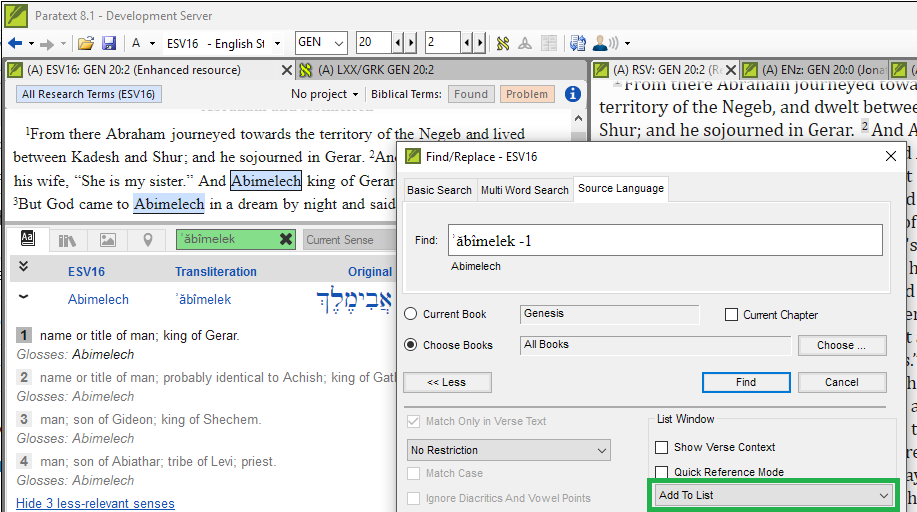
(2) In an Enhanced Resource (coming in Paratext 8.1), you’ll be able to get search results a different way. Click an English word in the ESV, or a French word in the NBS, etc., then use Ctrl+F to search for all occurrences of that sense (or that lemma in general). Searching both the OT and NT would require two searches, with the second one using “Add To List”. (If you wanted 4 custom terms for the 4 senses of Abimelech, that would be 8 searches.)
In either approach, building a long list of chasm-spanning names would be a lot of work, and it might be wasted effort if/when a better solution is made available.


较早的帖子 - 以原始语言显示
(264 分) 发布

All very good thoughts. But I am after specific people, like David, Abraham, who get mentioned in the OT and in the NT. This is normally done by a human editor, not a script or other tool. I believe I have seen paper books with such references and I was assuming such goodness is already hidden somewhere in PT. Was wondering where to find it, because somebody took the trouble for tools and animals, why not real personalities.

I am much less interested in linking terms like “farmer” in Greek and Hebrew.

较早的帖子 - 以原始语言显示

Sounds good to me! I definitely didn’t mean to imply that a tool could fully automate these linkages; just that we could perhaps provide recommended linkages between NT terms (mainly names, as you said) and OT terms which experts believe align closely with them. This would seem especially helpful when multiple people share a name, in which case a fully automated tool would be clueless anyway.

较早的帖子 - 以原始语言显示

Thank you for this very thorough and detailed response! Helped me to resolve a separate issue.

较早的帖子 - 以原始语言显示
0

Working with and checking names is an important task. The category “Person” includes professions like tanner or fisherman. It sounds like you want names like Phillip or Bartholomew.
Try using the Major Biblical terms list, then making a filter for the category “Name”. The Biblical terms tool will then only display names. You can further limit the list by setting the Scripture range to only the books you are working in.

较早的帖子 - 以原始语言显示
[Expert]
(2.9k 分) 发布
+1

I stumbled across this thread, and just wanted to add that one quick and dirty way that a team finishing up the whole Bible is dealing with this is to sort the Biblical Terms tool by gloss. Then they can compare the equivalent terms across NT/OT:

It’s not perfect (as the glosses don’t always line up), but they have found it helpful.

较早的帖子 - 以原始语言显示
(1.4k 分) 发布

Dear @jeffh, keep stumbling friend, this is a very helpful idea and input.

Firstly you have indirectly confirmed that our need is not some isolated weird thing, but that harmonizing between OT and NT is needed by other projects too.

Secondly I thank you for the actual idea of sorting that way; we will try that for sure.

Thirdly, this is an elegant and good way to address this need: So in my feature request I will not request yet another ressource (like the document on Biblical plants, or man-made-things), I will rather request that a qualified editor will have a look at the issue and will edit the glosses in such a way, that persons who are mentioned in the OT and NT will show up right next to each other (funny English; should I write “next to themselves”?) when sorted by gloss.

So all my thumbs up for your help, thank you.

较早的帖子 - 以原始语言显示

Looks like you are sorting on the English gloss. Yes that is a help, but there still are two entries for the same person. As I understand it, anon468618 was working on this problem of OT and NT names and some other Biblical terms list issues. I want to go and exercise the latest version of Paratext 9 and see where we are at on Biblical terms lists.

较早的帖子 - 以原始语言显示

相关问题

0
3 个回答 378 次浏览
I recently installed KTOT dictionary manually according to installation instructions, adding the .p8z and the configuration file ... appear there in the right-click menu either).
anon174473 109 发布 提问于 五月 12, 2020
0
4 个回答 681 次浏览
Right-click Find in Dictionary' shows only part of the entry in FLEx. This is what Paratext brings up: and this is what ... do display nicely: So now I need to figure out why
Paul 642 发布 提问于 六月 8, 2017
0
3 个回答 84 次浏览
这里提个醒,changes.txt 中的某些内容可能会导致新版 PDF 查看器的右键菜单被截断,只剩下 缩放至适合 和 缩放至 100% (没有缩小 放大或编辑样式的选项) 只有注释掉 changes.txt 中的所有内容后,我 ... 截断是由于文件中存在 \esb ... \esbe 标记(在我的情况下,这些标记是由 changes.txt 插入的)
mvk1000 206 发布 提问于 十二月 31, 2024
0
2 个回答 52 次浏览
我最近参与的一个项目中的计算机安装了 PT 9.5,它们现在正在使用 圣经术语 (Biblical Terms)工具中的斯瓦希里语释义 然而,在三台计算机中,有一台显示的斯瓦希里语释义条目数量明显少于另外两台(使用相同的圣经术语列表,且关于列出 ... 而不是释义 我推测相关文件可能以某种方式损坏了,但我不清楚它存储在哪里,以便复制一份干净的副本 谢谢
anon380150 242 发布 提问于 十月 30, 2025
Paratext
0
1 个回答 225 次浏览
我想处理某些圣经术语,以及这些术语应出现的译文经文列表。这可行吗?如果可行,该怎么做? 我想通过列表与一位没有 Paratext 访问权限的 MTT(机器翻译文本)合作者一起工作。由于我们远程协作,我需要发送 PDF 或 Word 文档。我希望打印输出如下所示: 救主- σωτήρ 路加福音 1:47 - 译文文本 路加福音 2:11- 译文文本 等等
Clear7419 251 发布 提问于 二月 9, 2024
Welcome to Support Bible, where you can ask questions and receive answers from other members of the community.
I urge you, brothers and sisters, to watch out for those who cause divisions and put obstacles in your way that are contrary to the teaching you have learned. Keep away from them.
Romans 16:17
3,045 个问题
6,005 个回答
5,671 条评论
2,026 位用户




