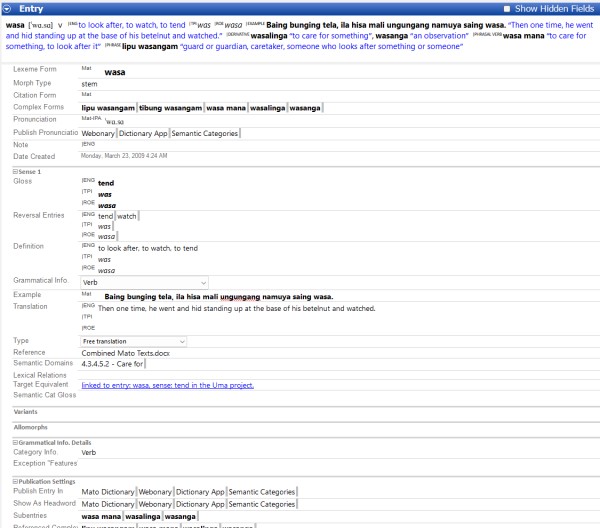
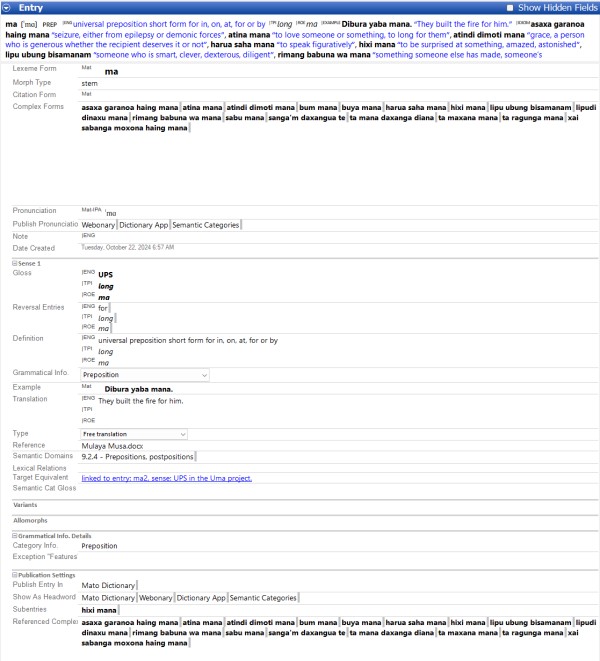
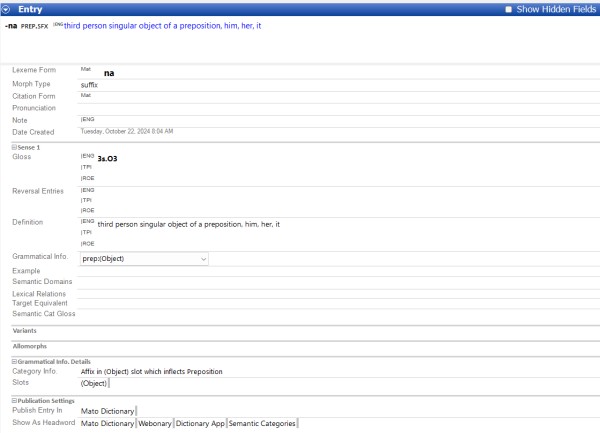
Dans la langue source, j'ai un verbe phrasal wasa mana signifiant « avoir tendance à / prendre soin de ». Il s'agit essentiellement du verbe « regarder » et d'une préposition universelle « dans/sur/à/pour/avec/par... » qui peut ou non avoir un complément. Dans mon lexique source, j'ai une entrée pour wasa (verbe) « regarder/avoir soin de », ma (forme courte de la préposition) « UPS », -na (& entrées pour d'autres compléments prépositionnels) « 3s.O3 », et aussi pour wasa mana (groupe nominal) « il/elle/ça a tendance à lui/elle/ça », qui est également défini comme un VERBE PHRASAL :
Mais, souvent lorsque j'analyse le texte, j'analyse chaque mot, comme dans l'exemple suivant tiré de Luc 20:28 :
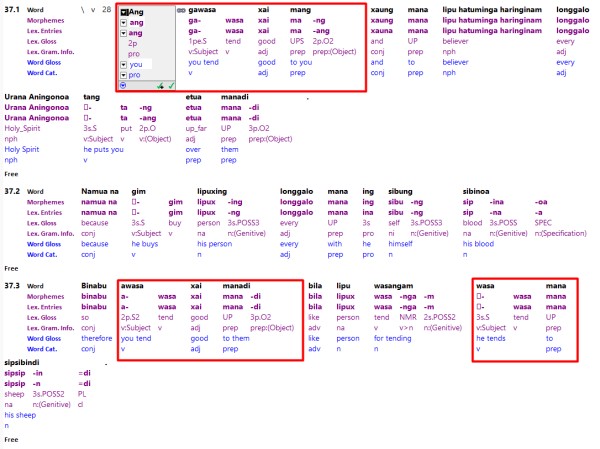
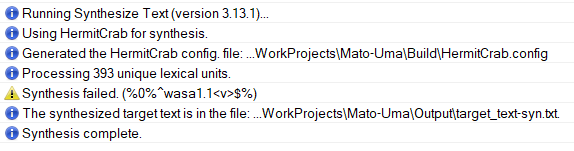
Dans les deux premiers exemples, il y a un mot interposé entre wasa et ma. Ces éléments sont transférés sans problème dans le module de rédaction. Mais dans le troisième cas, « wasa » ne parvient pas à se synthétiser, tandis que « mana » se synthétise parfaitement. Que se passe-t-il ici ?

In the source language, I have a phrasal verb wasa mana 'tend to/care for'. This is essentially a verb 'watch' and a universal preposition 'in/on/at/for/with/by...' which may or may not have an object. In my source lexicon, I have an entry for wasa (verb) 'watch/tend', ma (prep short form) 'UPS', -na (& entries for other prepositional objects) '3s.O3', and also for wasa mana (noun phrase) 'he/she/it tends to him/her/it', which is also defined as a PHRASAL VERB:
But, often when I am parsing the text, I am parsing each word, as in the following example from Luke 20:28:
In the first two examples, there is an intervening word between wasa and ma. These transfer fine in the drafting module. But in the third instance, the wasa fails to synthesize, while the mana sythesizes just fine. What is going on here?
Traduit automatiquement depuis English