我认为区别在于列表的构建方式。在大多数情况下,“All”列表是单独的词根(lemmas)。“Major”列表是经过精心构建的。例如,具有多重含义的词根被拆分为单独的条目(例如,1-צדק “be righteous”(行义),2-צדק “justify”(称义),和 3-צדק “declare righteous”(宣告为义)),并且该词根出现的所有引用列表都经过仔细排序,以将其与不同的含义关联起来。[旁注:这通常很有帮助,但有时你会对含义或语境进行不同的分析。]
更直接地回答你的问题,制作“Major”列表所付出的额外工作包括添加多词短语。这些非常有用,随着你的工作进展,你可能也会想添加一些自己的短语。例如,我添加了短语“these are the generations”(这是……的后代/世系,这是创世记中的一个关键结构元素,在路得记中巧妙重复),“the word of the Lord was/came”(耶和华的话临到/来到,这是一个引入神谕的关键短语,其含义比“神说”更多),以及“call out against”(大声呼喊反对)。
因为“All”列表实际上只是圣经中(几乎)所有单独词根(stems)的列表,所以你不会在其中找到短语。因此,“Major”列表不仅仅是一个更少的列表——它是一个更少的列表(省略了大多数单词)和一个更多的列表(按含义拆分单词,添加短语)。如果我在这里表述有误,我希望开发团队的某人能纠正我。
我使用的是“Biblical Terms…”(圣经术语……)工具,而不是“Biblical Terms Renderings”(圣经术语译法)工具。总的来说,“Renderings”(译法)工具似乎设计得只能让你做几件事:(1) 在圣经术语列表之间切换(一旦你构建了项目列表,你就停留在该列表上——除非你切换到,例如,“All”列表,以便在你想要添加到项目列表中的术语旁边加一个星号)。(2) 编辑你列表中术语的译法(双击条目,然后在条目的 Renderings 部分中,在单独的几行中添加你将该术语翻译为项目语言的所有方式)——你还可以编辑相关的术语表条目。(3) 编辑译法讨论笔记(双击星号左侧的小图标)。
“Biblical Terms…”工具除了做这三件事外,还做以下事情:(4) 对于源语言中出现目标术语的经文,它显示你输入的该术语译法是否出现在翻译项目中。(5) 允许你通过搜索英文释义、项目语言译法、源语言等来过滤列表。(6) 查看相关引用的其他翻译,并与项目翻译进行比较。(7) 在列表下方显示输入的译法,而无需双击条目。(8) 选择不同的翻译 [我对这个选项感到困惑,因为它不会改变术语列表!——我会一直将那个选择保留在你的项目上]。(9) 做许多其他很酷的事情,例如在你的项目文本中标记术语表术语的所有出现,以便你的印刷/数字输出以你选择的任何方式表明,已发布文本中的单词 X 有一个可以查找(或在应用程序中点击!)的术语表条目。
在我看来,“Biblical Terms Rendering”(圣经术语译法)工具仅适用于输入你的翻译将如何翻译术语列表中的特定术语(以及添加讨论笔记,添加/编辑术语表条目)。但为什么不在功能齐全的“Biblical Terms…”工具中这样做呢——该工具会即时反馈你添加的译法是否确实出现在所有相关引用中?这只是我的两美分意见。
是的,这很耗时。[给开发者的旁注:积极维护其圣经术语列表的翻译者/顾问将不断在列表之间切换,以将新项目添加到项目列表中。为此需要 4 次点击(菜单选项卡 … 选择圣经术语列表 … [点击列表] … 确定)。然后你必须重复该过程才能回到你的项目列表。虽然只需两次点击就可以切换翻译,但我不明白为什么任何人会这样做。如果工具中那个“更改翻译”选择列表可以被隐藏,而“选择列表”可以被赋予那个高度可访问且可见的位置,那就太好了!]
你必须找出自己最好的工作流程。我不喜欢做两遍:第一遍添加译法,然后做第二遍寻找要添加的其他相关术语——然后我还必须添加那些译法。并且逐节进行(而不是逐章进行),因为如果我看着整章,我更容易忽略重要术语。另一方面,这大大减慢了我的速度,我可能无法长期维持这种状态。如果你在检查一本书之前先做书籍研究,你也可以注意关键术语/概念,并在进行任何检查之前添加这些术语!仅供参考,这是我在这一阶段的屏幕截图:
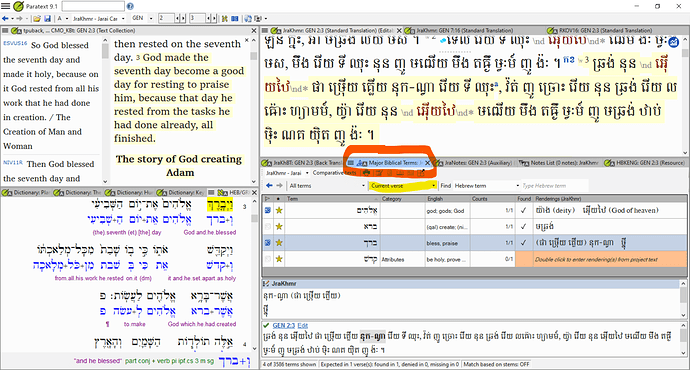
image1917×1028 597 KB
除了你在创 2:7 中看到的在我们项目列表中的术语外,我可能会从“All”列表中添加术语“rest”(安息/休息)——不是因为我们总是和到处都以完全相同的方式翻译那个词,而是因为我想要跟踪我们的做法,并确保当我们偏离“正常”翻译时是有正当理由的(而不是在没有考虑更大正典的情况下,在特定经文中凭感觉“自然”地翻译)。
希望这有帮助。
I think the difference is in how the lists are constructed. For the most part, the “All” list is individual lemmas. The “Major” list was carefully constructed. For example, lemmas with multiple senses were broken into separate entries (say, 1-צדק “be righteous”, 2-צדק “justify”, and 3-צדק “declare righteous”), and the full list of references where the lemma occurs is carefully sorted to associate them with the separate senses. [sidenote: this is often helpful, but sometimes you’ll analyze the senses or contexts differently.]
More to your actual question, the extra work that went into making the “Major” list included adding in multi-word phrases. These are VERY handy, and you’ll probably want to add some of your own as you go, too. For example, I’ve added the phrases “these are the generations” (a key structuring element in Genesis, artfully repeated in Ruth), “the word of the Lord was/came” (a key phrase introducing oracles that means more than “God said”), and “call out against”.
Because the “All” list is really just a list of (nearly) all the individual stems in the Bible, you won’t find phrases. So the “Major” list isn’t just a list with LESS – it’s a list with LESS (most words omitted) and MORE (words divided by senses, addition of phrases). I hope that someone from the development team corrects me if I’ve misstated things here.
I use the “Biblical Terms…” tool rather than the “Biblical Terms Renderings” tool. On the whole, the “Renderings” tool appears designed to let you do only a few things: (1) switch between Biblical Terms Lists (once you construct your project list, you stay on that – except when you switch to, say, the “All” list so you can put a star next to a term that you want added to your project list). (2) Edit the rendering of a term in your list (double-click on the entry, then add in, on separate lines in the Renderings section of an entry, all the ways you translate that term into the project’s language) – you can also edit the associated glossary entry. (3) Edit rendering discussion notes (double click on the little icon off to the left of the star).
The “Biblical Terms…” tool does those three things plus the following: (4) For verses where the target term appears in the source language, it shows whether or not your keyed-in rendering for the term occurs in the translation project. (5) Allows you to filter the list by searching the English gloss, the project language rendering, the source language, etc. (6) Look at other translations of the relevant references in comparison to the project translation. (7) Display the keyed in renderings below the list without having to double-click the entry. (8) Select a different translation [I am mystified by this option, since it doesn’t change the terms list! – I’d leave that selection on your project at all times]. (9) Do lots of other cool things like marking up all occurrences of a glossary term in your project text, so your print/digital output indicates (in whatever way you choose) that word X in the published text has a glossary entry that can be looked up (or clicked on in the app!).
As I see it, the “Biblical Terms Rendering” tool is ONLY good for keying in how your translation will translate a particular term in the terms list (and adding discussion notes, and adding/editing glossary entries). But why not do that in the full-featured “Biblical Terms…” tool – which shows instant feedback about whether the rendering you added actually appears in all the relevant references? That’s my 2c, anyway.
Yeah, it’s time-consuming. [Side-note to Developers: translators/advisors who actively maintain their Biblical Terms lists will be constantly switching between lists to add new items to the project list. To do this requires 4 clicks (Menu Tab … Select Biblical Terms list … [click on the list] … OK). Then you have to repeat the process to get back to your project list. In just two clicks you can switch translations, though it’s not obvious to me why anyone would ever do that. It would be nice if the “change translation” selection list that’s right in the tool could be buried, and the “select list” could be given that highly accessible and visible real estate!]
You’ll have to figure out your own best work flow. I hate to make two passes: a first pass adding renderings, then make a second pass looking for additional relevant terms to add – and then I have to add those renderings too. And do it verse-by-verse (rather than chapter-by-chapter), since I’m more likely to overlook an important term if I’m looking at a whole chapter. On the other hand, it slows me down considerably, and I may not be able to sustain this long-term. If you do a book study before checking a book, you can also pay attention to key terms/concepts and add those terms before doing any checking! For what it’s worth, here’s what my screen looks like at this stage:
image1917×1028 597 KB
In addition to the terms you see for Gen. 2:7 that are in our project list, I’ll probably add the term “rest” from the “All” list – not because we’ll always and everywhere translate that word exactly the same, but because I want to keep track of what we do and make sure we’re justified when we diverge from the “normal” translation (instead of translating however feels “natural” in a particular verse without thinking about the larger canon).
I hope this helps.