Si mi copia de su proyecto de FLEx sigue siendo precisa, tiene 13 afijos que podrían ir en el hueco de genitivo y 1 que puede ir en el hueco de asociativo.
El método a la fuerza bruta sería que la primera parte de su declaración and compruebe si el afijo asociativo está presente, y la segunda parte de su declaración and sería una larga declaración or que comprobaría la igualdad con cada uno de los 13 afijos.
Una forma menos larga de hacer la segunda parte sería comprobar si el afijo termina con POSS1 o POSS2 o POSS3. Podría verse así:
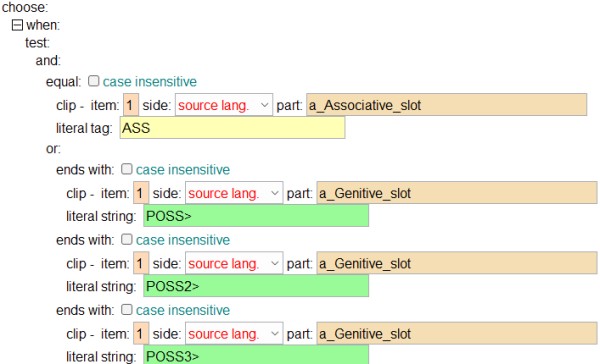
Tenga en cuenta que no puede usar una literal tag con la declaración ends with, debe usar literal string y terminarla con un >, que es el marcador de fin para una etiqueta.
Un enfoque diferente sería hacer toda la enumeración en la definición de categoría. Podría verse así:
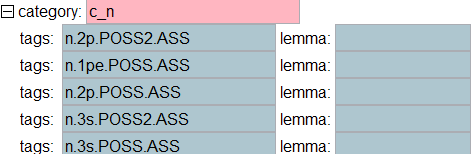
Por supuesto, esta es solo una lista parcial y es posible que tenga que agregar a la lista para cada una de sus categorías de sustantivos. na, ni, etc.
La ventaja de esto es que hace toda la enumeración en la categoría y tiene una regla usando esa categoría donde ya sabe que se han cumplido todas las condiciones y puede hacer los cambios necesarios.
Me gustaría saber qué decide hacer al final.
If my copy of your FLEx project is still accurate you have 13 affixes that could go in the genitive slot and 1 that can go in the associative slot.
The brute force method would be to have the first part of your and statement check if the 1 associative affix is present, the second part of your and statement would be a long or statement that would check equality with each of the 13 affixes.
A less long way to do the second part would be to check if the affix ends with POSS1 or POSS2 or POSS3. It might look like this:
Note that you can't use a literal tag with the ends with statement you have to use literal string and end it with a > which is the end marker for a tag.
A different approach would be to do all the enumerating in category definition. It might look like this:
Of course, this is just a partial list and you may have to add to the list for each of your noun categories. na, ni, etc.
The advantage of this, is you do all the enumerating in the category and have a rule using that category where you already know all the conditions have been met and you can do the changes needed.
I'd be curious to know what you end up choosing to do.
Traducción automática desde English