Não tenho certeza total do que o python faz, mas (supondo que as aspas, conforme chegam à parte do XeTeX das coisas, sejam reconhecidas como marcas de citação) e não houver espaços etc. entre elas, ele adicionará \quotekernamount de espaço entre elas. Não tenho certeza total do porquê, mas o código atualmente diz \quotekernamount=0pt. Se for 0pt, então o único kerning entre os caracteres depende do kerning embutido da fonte.
Também, não consigo ver nenhum controle na interface do usuário do PTXprint no momento, nem mesmo na página de truques do TeXpert. Ops.
Claro, você pode ir para a guia avançada,
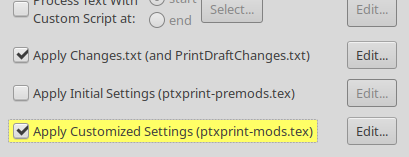
Certifique-se de que há um sinal de verificação em aplicar configurações personalizadas,
clique em “Editar” e, em seguida, adicione uma linha como esta:
\quotekernamount=0.3ex
(onde 1ex é a altura de um x na fonte, você pode, claro, usar uma dimensão absoluta, como pt ou mm, etc.)
A lista atual de aspas para as quais isso se aplica é:
U+201C ASPA DE ABERTURA DUPLA ESQUERDA
U+2018 ASPA DE ABERTURA SIMPLES ESQUERDA
U+201D ASPA DE FECHAMENTO DUPLA DIREITA
U+2019 ASPA DE FECHAMENTO SIMPLES DIREITA
Idealmente, a mesma lógica também seria aplicada às aspas baixas, mas presumo que não deva ser aplicada a misturas de aspas altas e baixas.
I’m not entirely sure what the python does, but (assuming that the quotes as they get through to the XeTeX portion of things are recognised as quotation marks) with no spaces, etc. between them, then it will add \quotekernamount of space between them. I’m not entirely sure why, but the code currently says \quotekernamount=0pt. If it is 0pt, then the only kerning between the characters depends on the font’s in-built kerning.
Also, I can’t see any control in PTXprint’s user interface at the moment, not even on the TeXpert hacks page. Oops.
You can of course go to the advanced tab,
Ensure that there’s a tick / check on apply customised settings,
click on “Edit”, and then add a line something like:
\quotekernamount=0.3ex
(where 1ex is the height of an x in the font, you can of course use an absolute dimension, like pt or mm, etc)
The current list of quotes for which this apply are:
U+201C LEFT DOUBLE QUOTATION MARK
U+2018 LEFT SINGLE QUOTATION MARK
U+201D RIGHT DOUBLE QUOTATION MARK
U+2019 RIGHT SINGLE QUOTATION MARK
Ideally, it would also apply the same logic to low quotes, but I presume it should not apply it to mixtures of high and low quote marks.