Olá.
Se você estiver usando a opção de afixos e não quiser colocar asteriscos, o que resta é colocar ambas as formas como corretas, uma por linha (nyasɨ gɨ lagɨ yɨ mbɛ e nyasɨ gɨ lagɨ yɨ mbɔ). Dessa forma, o Paratext reconhecerá ambas as formas e as relacionará bem com os outros sufixos (como -nɨ e -bha).
Outra opção é registrar a expressão sem o último caractere (nyasɨ gɨ lagɨ yɨ mb) e adicionar a última letra à lista de afixos (ɛ e ɔ). O Paratext conjugará bem quando qualquer um dos caracteres existir e também reconhecerá os outros sufixos, se estiverem presentes).
Um exemplo em inglês seria adicionar "wide" como uma tradução aprovada e deixar o Paratext encontrar "widely", "widen", "wideness", "wider", "widest", "widish" e "width" como traduções válidas.
---
Outra opção diferente é usar "Match based on stems" (nas Propriedades do Projeto - aba Associações). AVISO: Se essa opção for ativada, os Termos Bíblicos deixarão de considerar os afixos inseridos.
Com essa opção, ele não usa os afixos, mas os Termos Bíblicos obtêm as informações da Lista de Palavras e do Interlinearizador.
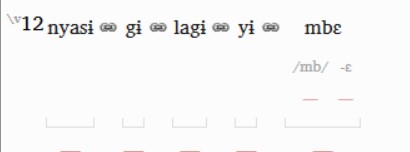
Para o seu caso, eu simplesmente adicionaria nyasɨ gɨ lagɨ yɨ mb nos Termos Bíblicos e faria a análise da palavra no Interlinearizador:
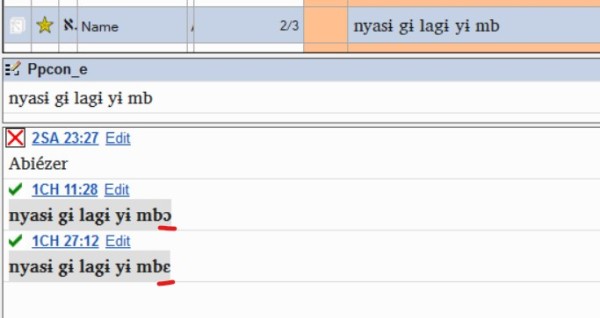
Os Termos Bíblicos reconhecerão isso:
Observe que isso seria uma grande mudança, pois deveria funcionar assim para todos os seus termos. Faça essa mudança apenas se você tiver tempo necessário para a análise e se os benefícios forem maiores.
Você pode encontrar mais informações sobre os prós e contras na ajuda do Paratext.
Saudações,
Pepe.
Hello.
If you are using the affix option and do not want to put asterisks, what is left is to put both forms as correct one per line (nyasɨ gɨ lagɨ yɨ mbɛ and nyasɨ gɨ lagɨ yɨ mbɔ). This way Paratext will recognize both forms and relate it well with the other suffixes (such as -nɨ and -bha).
Another option is to record the expression without the last character (nyasɨ gɨ lagɨ yɨ mb) and add the last letter to the list of affixes (ɛ and ɔ). Paratext will conjugate well when either character exists and will also recognize the other suffixes if they were present).
An example with English would be add "wide" as an approved rendering and let Paratext find "widely", "widen", "wideness", "wider", "widest", "widish" and "width" as valid renderings.
---
Another different option is to use "Match based on stems" (in Project properties - Associations tab). WARNING: If this option is activated, Biblical Terms stops considering the entered affixes.
With this option it does not use the affixes but Biblical Terms takes the information from the Word List and the Interlinearizer.
For your case I would just add nyasɨ gɨ lagɨ yɨ mb in Biblical Terms and do the word analysis in the Interlinelizer:
Biblical Terms will recognize this:
Note that this would be a big change as it should work this way for all your terms. Make this change only if you will allocate the necessary time for the analysis and if the benefits are better.
You can find more information about the pros and cons in the Paratext help.
Saludos,
Pepe.








