Halo.
Jika Anda menggunakan opsi afiks dan tidak ingin menempatkan tanda bintang, yang tersisa adalah menempatkan kedua bentuk sebagai yang benar, satu per baris (nyasɨ gɨ lagɨ yɨ mbɛ dan nyasɨ gɨ lagɨ yɨ mbɔ). Dengan cara ini Paratext akan mengenali kedua bentuk dan menghubungkannya dengan baik dengan akhiran lain (seperti -nɨ dan -bha).
Opsi lain adalah merekam ekspresi tanpa karakter terakhir (nyasɨ gɨ lagɨ yɨ mb) dan menambahkan huruf terakhir ke daftar afiks (ɛ dan ɔ). Paratext akan berkonjugasi dengan baik ketika salah satu karakter ada dan juga akan mengenali akhiran lain jika ada).
Sebuah contoh dengan bahasa Inggris adalah menambahkan "wide" sebagai terjemahan yang disetujui dan membiarkan Paratext menemukan "widely", "widen", "wideness", "wider", "widest", "widish" dan "width" sebagai terjemahan yang valid.
---
Opsi lain yang berbeda adalah menggunakan "Match based on stems" (di Properti Proyek - tab Asosiasi). PERINGATAN: Jika opsi ini diaktifkan, Istilah Alkitab berhenti mempertimbangkan afiks yang dimasukkan.
Dengan opsi ini, ia tidak menggunakan afiks tetapi Istilah Alkitab mengambil informasi dari Daftar Kata dan Interlinearizer.
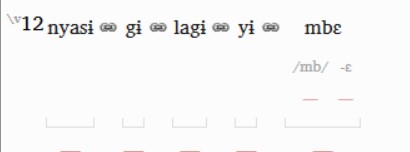
Untuk kasus Anda, saya akan menambahkan nyasɨ gɨ lagɨ yɨ mb di Istilah Alkitab dan melakukan analisis kata di Interlinelizer:
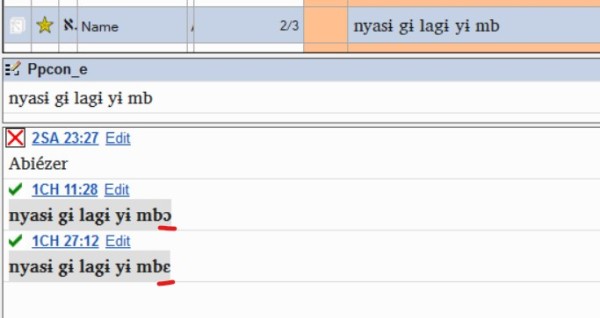
Istilah Alkitab akan mengenali ini:
Perhatikan bahwa ini akan menjadi perubahan besar karena seharusnya bekerja dengan cara ini untuk semua istilah Anda. Lakukan perubahan ini hanya jika Anda akan mengalokasikan waktu yang diperlukan untuk analisis dan jika manfaatnya lebih baik.
Anda dapat menemukan lebih banyak informasi tentang kelebihan dan kekurangan di bantuan Paratext.
Salam,
Pepe.
Hello.
If you are using the affix option and do not want to put asterisks, what is left is to put both forms as correct one per line (nyasɨ gɨ lagɨ yɨ mbɛ and nyasɨ gɨ lagɨ yɨ mbɔ). This way Paratext will recognize both forms and relate it well with the other suffixes (such as -nɨ and -bha).
Another option is to record the expression without the last character (nyasɨ gɨ lagɨ yɨ mb) and add the last letter to the list of affixes (ɛ and ɔ). Paratext will conjugate well when either character exists and will also recognize the other suffixes if they were present).
An example with English would be add "wide" as an approved rendering and let Paratext find "widely", "widen", "wideness", "wider", "widest", "widish" and "width" as valid renderings.
---
Another different option is to use "Match based on stems" (in Project properties - Associations tab). WARNING: If this option is activated, Biblical Terms stops considering the entered affixes.
With this option it does not use the affixes but Biblical Terms takes the information from the Word List and the Interlinearizer.
For your case I would just add nyasɨ gɨ lagɨ yɨ mb in Biblical Terms and do the word analysis in the Interlinelizer:
Biblical Terms will recognize this:
Note that this would be a big change as it should work this way for all your terms. Make this change only if you will allocate the necessary time for the analysis and if the benefits are better.
You can find more information about the pros and cons in the Paratext help.
Saludos,
Pepe.
Diterjemahkan secara otomatis dari English








