Hola.
Si estás usando la opción de afijos y no quieres poner asteriscos, lo que queda es poner ambas formas como correctas, una por línea (nyasɨ gɨ lagɨ yɨ mbɛ y nyasɨ gɨ lagɨ yɨ mbɔ). De esta manera, Paratext reconocerá ambas formas y las relacionará bien con los otros sufijos (como -nɨ y -bha).
Otra opción es registrar la expresión sin el último carácter (nyasɨ gɨ lagɨ yɨ mb) y añadir la última letra a la lista de afijos (ɛ y ɔ). Paratext conjugará bien cuando exista cualquiera de los dos caracteres y también reconocerá los otros sufijos si estuvieran presentes).
Un ejemplo en inglés sería añadir "wide" como una traducción aprobada y dejar que Paratext encuentre "widely", "widen", "wideness", "wider", "widest", "widish" y "width" como traducciones válidas.
---
Otra opción diferente es usar "Match based on stems" (en Propiedades del proyecto - pestaña Associations). ADVERTENCIA: Si se activa esta opción, Biblical Terms deja de considerar los afijos introducidos.
Con esta opción no se usan los afijos, pero Biblical Terms toma la información de la Word List y del Interlinearizer.
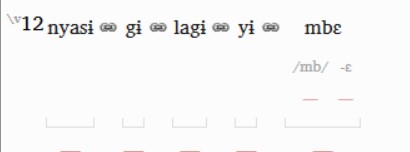
Para tu caso, simplemente añadiría nyasɨ gɨ lagɨ yɨ mb en Biblical Terms y haría el análisis de la palabra en el Interlinelizer:
Biblical Terms reconocerá esto:
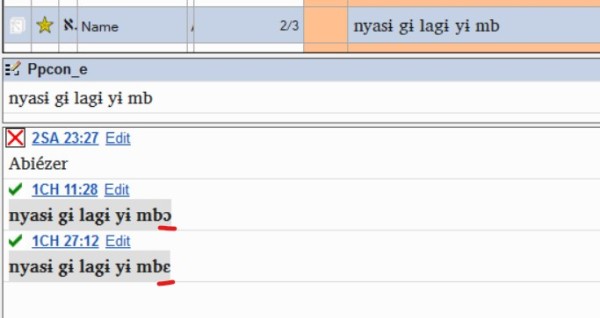
Nota que esto supondría un gran cambio, ya que debería funcionar de esta manera para todos tus términos. Haz este cambio solo si vas a dedicar el tiempo necesario para el análisis y si los beneficios son mejores.
Puedes encontrar más información sobre los pros y los contras en la ayuda de Paratext.
Saludos,
Pepe.
Hello.
If you are using the affix option and do not want to put asterisks, what is left is to put both forms as correct one per line (nyasɨ gɨ lagɨ yɨ mbɛ and nyasɨ gɨ lagɨ yɨ mbɔ). This way Paratext will recognize both forms and relate it well with the other suffixes (such as -nɨ and -bha).
Another option is to record the expression without the last character (nyasɨ gɨ lagɨ yɨ mb) and add the last letter to the list of affixes (ɛ and ɔ). Paratext will conjugate well when either character exists and will also recognize the other suffixes if they were present).
An example with English would be add "wide" as an approved rendering and let Paratext find "widely", "widen", "wideness", "wider", "widest", "widish" and "width" as valid renderings.
---
Another different option is to use "Match based on stems" (in Project properties - Associations tab). WARNING: If this option is activated, Biblical Terms stops considering the entered affixes.
With this option it does not use the affixes but Biblical Terms takes the information from the Word List and the Interlinearizer.
For your case I would just add nyasɨ gɨ lagɨ yɨ mb in Biblical Terms and do the word analysis in the Interlinelizer:
Biblical Terms will recognize this:
Note that this would be a big change as it should work this way for all your terms. Make this change only if you will allocate the necessary time for the analysis and if the benefits are better.
You can find more information about the pros and cons in the Paratext help.
Saludos,
Pepe.