Hola anon421222,
¡Gracias por esa información! Por lo que puedo ver, mi proyecto ya está configurado como Unicode y
Caracteres Compuestos (¡mira la captura de pantalla a continuación!). A la izquierda está el cuadro de diálogo Convertir proyecto, que no
muestra la opción de Caracteres Compuestos. Pero a la derecha, las Propiedades del proyecto parecen mostrar que
el proyecto está configurado como Unicode (es decir, aparece Unicode y el botón está deshabilitado) y Caracteres Compuestos.
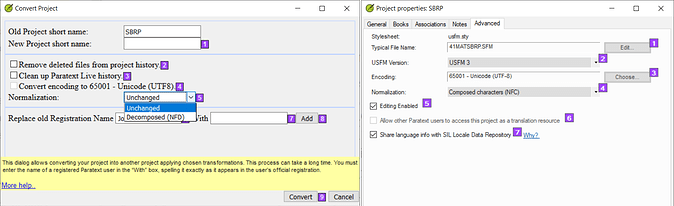
image.png1605×492 136 KB
Alguien de PTXPrint me dijo que mirara el final del registro de XeTeX y, según su sugerencia, encontré lo
siguiente:
Missing character: There is no ꞌ (U+A78C) in font MarkTNR Satere! > ꞌ = U+0027
Missing character: There is no ỹ (U+1EF9) in font MarkTNR Satere! > ỹ = U+00FF
Missing character: There is no ẽ (U+1EBD) in font MarkTNR Satere! > ẽ = U+00E6
Missing character: There is no ĩ (U+0129) in font MarkTNR Satere! > ĩ = U+00F0
El idioma Satere-Mawe (SAT) utiliza vocales nasalizadas, y nasalizada y el apóstrofo recto para la glotal.
MarkTNR Satere es la fuente que uso, pero el número Unicode del carácter faltante es diferente del mismo carácter
en la fuente que uso (es decir, después del símbolo >).
Por lo tanto, los símbolos rectangulares de caracteres no reconocidos que aparecen cuando imprimo usando PTXPrint son los
caracteres faltantes anteriores. De alguna manera, la entrada en Paratext parece no estar usando la fuente MarkTNR Satere, aunque esta es
la fuente que está configurada en el proyecto.
Un par de personas han sugerido que el proyecto se puede convertir de alguna manera para que no
necesite usar una fuente especial. Pero nadie ha explicado realmente cómo lograr esto. Estoy dispuesto a hacer el trabajo, pero no
sé qué hacer. He intentado investigar la conversión del proyecto, pero aparentemente ya está configurado para Unicode y Caracteres Compuestos.
A continuación hay una captura de pantalla del error que obtengo al usar PTXPrint para imprimir en PDF. Los caracteres faltantes en Levítico parecen ser
la glotal, pero en otros libros son las vocales nasalizadas las que no se reconocen.
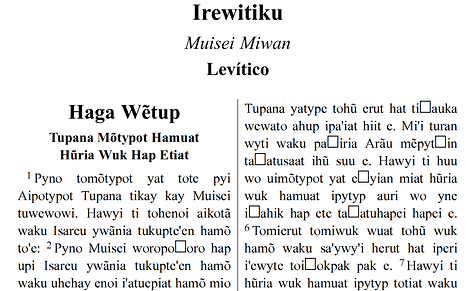
image.png1298×800 122 KB
¡Su ayuda es muy apreciada! ¡Dios te bendiga!
anon165192
Hi anon421222,
Thank you for that information! As far as I can tell my project is already configured as unicode and
Composed Characters (see screenshot below)! On the left is the Convert Project dialog which doesn’t
show the option for Composed Characters. But on the right the Project Properties appear to show that
the project is configured as unicode (i.e. unicode appears and button is disabled) and Composed Characters?
image.png1605×492 136 KB
Someone from PTXPrint told me to look at the end of the XeTeX Log and as per their suggestion I found the
following:
Missing character: There is no ꞌ (U+A78C) in font MarkTNR Satere! > ꞌ = U+0027
Missing character: There is no ỹ (U+1EF9) in font MarkTNR Satere! > ỹ = U+00FF
Missing character: There is no ẽ (U+1EBD) in font MarkTNR Satere! > ẽ = U+00E6
Missing character: There is no ĩ (U+0129) in font MarkTNR Satere! > ĩ = U+00F0
The Satere-Mawe (SAT) language uses nasalized vowels, nasalized y and the straight apostrophe for the glottal.
MarkTNR Satere is the font I use, but the missing character’s unicode number is different from the same character
in the font I use (i.e. after the > symbol).
Therefore, the retangular unrecognized character symbols which appear when I print using PTXPrint are the missing
characters above. Somehow the input in Paratext appears not to be using the MarkTNR Satere font although this is
the font which is configured in the project?
A couple of people have suggested that the project can be converted in some way so that I anon421222’t need to use a special
font. But no one has actually explained how to achieve this? I’m willing to do the work, but I anon421222’t know what to do! I
have tried looking into converting the project, but it apparently is already configured for unicode and Composed Characters?
Below is a screenshot of the error I get when using PTXPrint to print to PDF. The missing characters in Leviticus appear to be
the glottal, but in other books it is the nasalized vowels which are not being recognized?
image.png1298×800 122 KB
Your help is greatly appreciated! God bless!
anon165192