0 votes
15 views

This post has 2 questions: 1. How do I tell where a synthesis error is occurring? I'm getting the following error when running the Drafting collection (focus on the 3s.POSS3 error, not the samoya1.1 error):
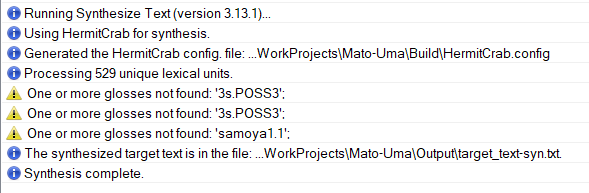
I have an inkling of what's happening, but can't pinpoint the culprit. There are 3s.POSS3 tags all over the text, and I have a rule that converts them to 3s.POSS2 tags, since the target language doesn't have the 3rd form of the possessive suffix.

So, if I look at the resulting translation, I notice the following (source followed by target):
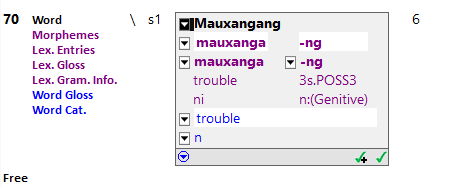
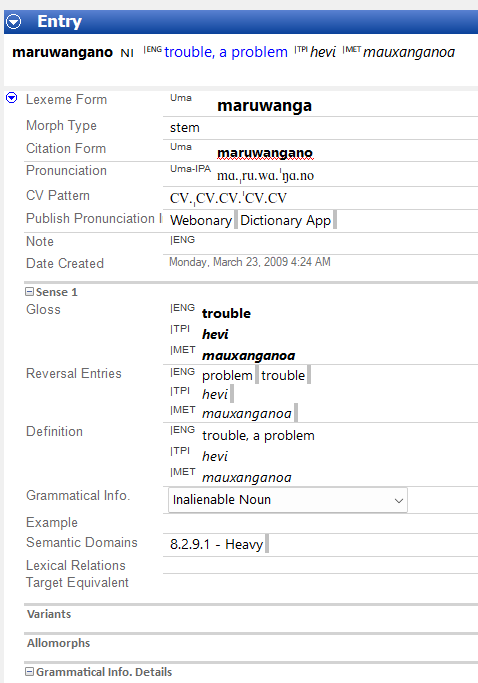
This tells me 2 things. Some kind of error is happening here, because the capitalization is not carrying over to the target translation. Also the target word is the citation form of the inalienable noun, not the lexeme form suffixed with the 3s.POSS2 tag.
But if I run the live rules tester, I get the correct result:
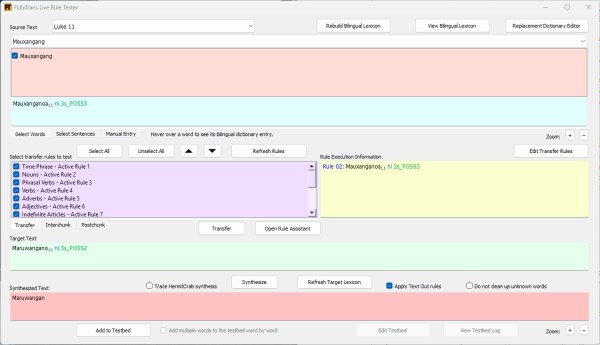
So, my second question is: 2. What is going on here?


FLExTrans by (122 points)
reshown by | 15 views

1 Answer

0 votes

I noticed you had the Clean Up Unknown Target Words set to 'Yes'. That's useful in many cases, but can make it hard to troubleshoot problems.

If you set this to 'No' then you will see %0%... for every word that doesn't synthesize. That would help you zero in on the few words that didn't synthesize. I think 3 or 4 in this case.

When you see that something is working in the Live Rule Tester, but not in the Drafting modules a good question to ask yourself is if there is some context before or after the word that could be the difference. (And initially you might want to check if all rules are turned on for testing in the LRT.) The context seems to be the issue here. When I combined the single word 'Mauxangang' above with the next word 'Yesu' it trigger the application of your Time Phrase rule.

It may not be obvious, but even though the 1st word is on one line and the 2nd word is on a subsequent line, to the transfer engine they are side by side in the data stream. Because of this, the two words together triggered the Time Phrase rule. In that rule, if your specific noun is not matched, you merely output the noun the same way it came in. Critically, the 3s.POSS3 doesn't get converted and then the synthesizer doesn't recognize that affix. You would need to process that noun as a normal noun if it doesn't match the criteria to be the time phrase.

by (336 points)

Related questions

0 votes
1 answer 22 views
How do I run a synthesis self-test on a text in my Target Project?
Sara 246 asked Apr 28, 2025
0 votes
1 answer 134 views
This is something I've run across before, but never really addressed it. In some dialects (like North Junín), the root yaćha- can mean ... of the 1.1, 1.2, 2.1, etc. in FLExTrans?
markebean 110 asked Sep 24, 2024
0 votes
2 answers 22 views
I would expect to be able to do this by making a lexical entry for the null morpheme on the target side, ... tag being appended to the successfully synthesized part of the output.
Dave Havens 106 asked May 21
0 votes
1 answer 29 views
How do I handle a source word that maps to two different target words depending on the inflection of the source word?
Sara 246 asked Apr 28, 2025
0 votes
1 answer 132 views
How do I handle noun agreement? (How do I get a target word or words to agree with a noun?)
rmdiamondl 336 asked May 8, 2022
Welcome to Support Bible, where you can ask questions and receive answers from other members of the community.
They devoted themselves to the apostles’ teaching and to fellowship, to the breaking of bread and to prayer.
Acts 2:42
3,041 questions
5,996 answers
5,663 comments
2,023 users




