Olá, Paul,
Só para avisar que você descobriu um bug (recentemente introduzido). Deveria funcionar apenas digitando uma série de referências como você fez:
ISA 2:1-5 PSA 122 ROM 13:11-14 MAT 24:36-44 ISA 11:1-10 PSA 72:1-7,18-19 ROM 15:4-13 MAT 3:1-12
…mas obviamente não funcionou. Vamos trabalhar para corrigir isso o mais rápido possível; mas, como Phil Leckrone apontou, a longo prazo você pode ficar melhor aprendendo a usar um arquivo de Módulo – especialmente porque você pode adicionar material de transição, etc.
Observe que na verdade existem 3 maneiras de fazer um módulo:
i) Criando o módulo dentro do Paratext usando um dos livros XXA…G e, em seguida, selecionando aquele livro XX? no PTXprint usando a opção Livro Único
ou
ii) Digitando a lista de Livros, capítulos e versículos [atualmente quebrado!]
ou
iii) Criando a especificação do módulo (algo como myLectionary.sfm) e, em seguida, dizendo ao PTXprint para imprimir diretamente a partir dessa especificação
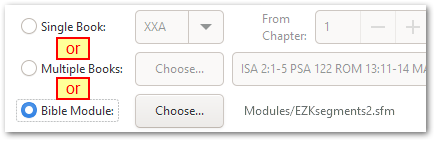
Há diferenças sutis entre cada uma dessas abordagens, e você pode descobri-las.
Hi Paul,
Just to let you know that you’ve uncovered a (recently introduced) bug. It should just work to type in a bunch of references as you did:
ISA 2:1-5 PSA 122 ROM 13:11-14 MAT 24:36-44 ISA 11:1-10 PSA 72:1-7,18-19 ROM 15:4-13 MAT 3:1-12
…but it obviously didn’t. We’ll work on fixing that ASAP; but as Phil Leckrone pointed out, you may be better off longer term learning how to use a Module file – especially as you can add bridging material etc.
Note that there are actually 3 ways of doing a module:
i) Creating the module within Paratext using one of the XXA…G books and then selecting that XX? book within PTXprint using the Single Book option
or
ii) Typing in the list of Books chapters and verses [currently broken!]
or
iii) Creating the module specification (something like myLectionary.sfm) and then telling PTXprint to print directly from that specification
There are subtle differences between each of these approaches, and you might discover them.








