Mirando la ayuda en Flex sobre 02BC, leemos lo siguiente:
02BC MODIFIER LETTER APOSTROPHE está definido como formador de palabras en el Estándar Unicode, por lo que su uso sería apropiado, .....
Si ya tiene un teclado especial, agregar 02BC probablemente no sería demasiado difícil. De lo contrario, use 0027 APOSTROPHE. Esto no tiene la apariencia redondeada, pero está disponible en todas las fuentes y no requiere nada especial para ingresarlo.
En el momento en que hicimos la elección por 02BC, fue exactamente la apariencia redondeada la que "inclinó la balanza" a favor de 02BC en comparación con 0027. Queríamos que las Escrituras impresas (así como la aplicación) tuvieran el apóstrofo tipo rizado manuscrito. Podríamos volver a 0027 si Charis tiene un glifo rizado alternativo, pero también requeriría cambiar los archivos de Keyman por completo. (Mi suposición es al menos para toda África Occidental, donde el uso de 02BC para la elisión se ha convertido en una práctica común).
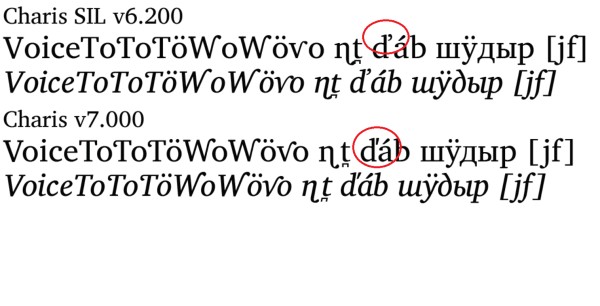
Mirando el conjunto de glifos de 0027, no hay un glifo alternativo para el ' "feo" ... Mirando la imagen a continuación de la documentación de Charis 7.0, parece haber habido un cambio en la forma en que se implementa ahora el apóstrofo (aunque no puedo encontrar una mención de ello en la documentación)
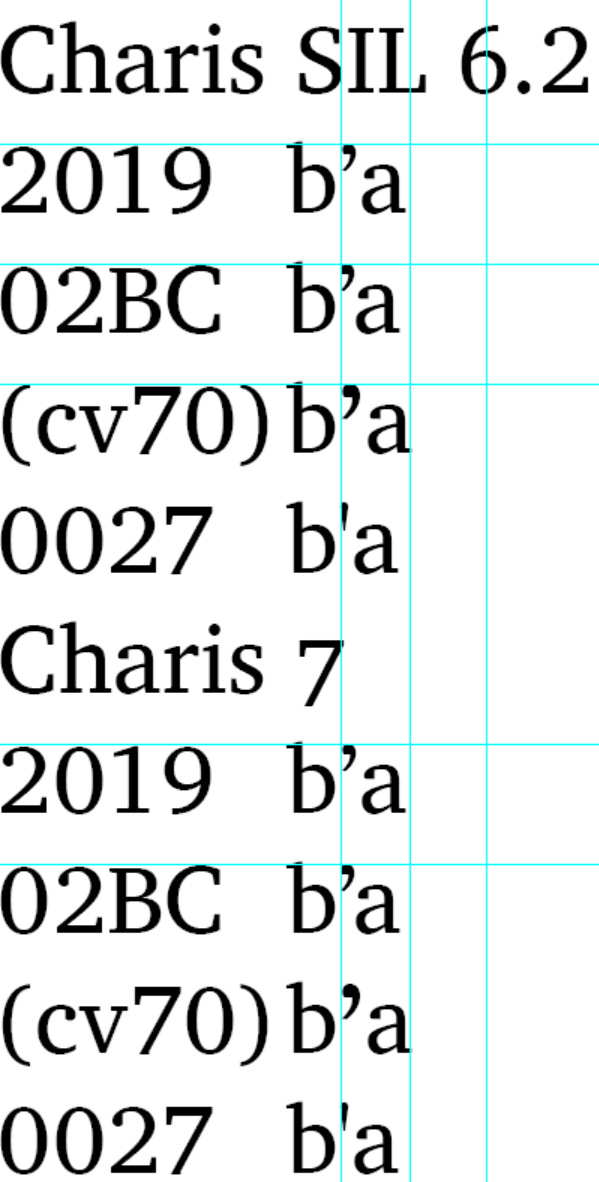
Si comparo Charis SIL 6.2 con Charis 7.0, no parece haber una diferencia:
Nuestros lectores se han acostumbrado al apóstrofo rizado, por lo tanto 0027 no es (todavía) una opción. Creo que por el momento las opciones son: 1: volver a Paratext 9.4 por el momento. 2: validar todas las combinaciones de [C]+02BC en el inventario de caracteres.
La pregunta sigue siendo si el cambio de 9.4 a 9.5 afecta la función de puente a Flex para palabras con un 02BC medial.
Looking at the help in Flex concerning 02BC, we read the following:
02BC MODIFIER LETTER APOSTROPHE is defined as word-forming in the Unicode Standard so its use would be appropriate, .....
If you already have a special keyboard, adding 02BC probably would not be too hard. Otherwise, use 0027 APOSTROPHE. This does not have the rounded appearance, but it is available in all fonts and does not require anything special to enter it.
At the time we made the choice for 02BC, it was exactly the rounded appearance, which "tipped the balance" in favour for 02BC as compared to 0027. We wanted the printed Scriptures (as well as the app) have the hand-written curly-type apostrophe. We could go back to 0027, if Charis has an alternative curly glyph, but it would also require changing keyman files across the board. (My guess is at least for all West Africa, where the use of 02BC for elision, has become common practice).
Looking at the Glyph set of 0027, there is no alternative glyph for the "ugly" ' ... Looking at the image below of the Charis 7.0 documentation there seems to have been a change in the way the apostrophe is now implemented (although I cannot find a mention of it in the documentation)
If I compare Charis SIL 6.2 with Charis 7.0 there does not seem te be a difference:
Our readers have become used to the curly apostrophe, therefore 0027 is (still) not an option. I think for the time being the choices are 1: go back to Paratext 9.4 for the time being. 2: validate all combinations of [C]+02BC in the character inventory.
The questions remains whether the change from 9.4 to 9.5 affects the bridge function to Flex for words with a medial 02BC.
Traducción automática desde English