@rickarellanes Merci pour cette question. Évidemment, nous ne voulons pas que cela soit trop facile à faire - car nous pourrions tout à fait facilement (et involontairement) nous retrouver avec des Écritures joliment formatées mais avec des entités entières manquantes, et peut-être que personne ne s'en apercevrait. C'est loin d'être idéal. L'objectif de l'option « Bridge Empty Verses » est donc de s'assurer qu'il soit évident qu'une partie du texte est manquante.
Mais oui, si vous voulez intentionnellement n'imprimer que certaines parties du texte, il existe un moyen de le faire. Cela s'appelle un « Module ». Et un module, dans sa forme la plus simple, est essentiellement une liste de références que vous souhaitez extraire (et imprimer) du texte. Recherchez « Module » dans l'aide de Paratext et vous y trouverez plus d'informations. Par exemple, ci-dessous, voici un module pour le livre d'Ézéchiel :
\ref EZK 1:1-9
\ref EZK 1:22-27
\ref EZK 1:28-2:5
\ref EZK 34:11-15
\ref EZK 37:1-14
Enregistrez cela comme un fichier texte brut et placez-le dans le dossier Modules de votre projet, ou dans le dossier « _Modules » de Paratext, puis vous pourrez l'appeler depuis PTXprint pour produire un PDF ne contenant que ces extraits de texte.
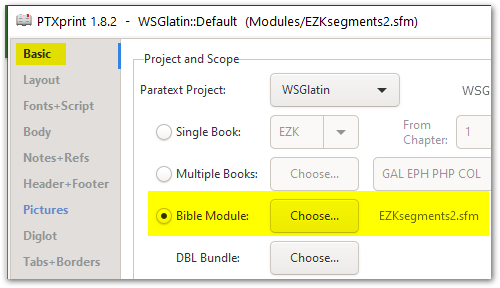
Dans PTXprint, vous pouvez sélectionner un module à partir de l'onglet Basic (Basic) (lorsque la vue Advanced (Avancée) est activée) :
Notez qu'il existe d'autres codes qui peuvent être utilisés pour rendre le module plus intéressant et structuré. Par exemple, le module suivant inclut un titre de livre, de nouveaux en-têtes de section et des références « localisées » utilisant la notation $(EZK 1:22-27).
\id MOD Ezekiel segments
\mt2 Demo of the book of
\mt1 Ezekiel
\inc v
\s1 There is hope
\s2 Ezekiel's vision of God
\sr $(EZK 1:1-9)
\ref EZK 1:1-9
\sr $(EZK 1:22-27)
\ref EZK 1:22-27
\s2 God calls Ezekiel
\sr $(EZK 1:28-2:5)
\ref EZK 1:28-2:5
\s2 Sheep without a shepherd
\sr $(EZK 34:11-15)
\ref EZK 34:11-15
\s2 The valley of dry bones
\sr $(EZK 37:1-14)
\ref EZK 37:1-14
Produira quelque chose qui ressemble à ceci :
Notez que les numéros de chapitre \c peuvent devoir être masqués à moins que vous ne commenciez au verset 1. Et il peut y avoir d'autres choses à corriger pour obtenir le résultat final que vous recherchez.
@rickarellanes Thanks for this question. Obviously we don’t want to make this too easy for people to do - as we could quite easily (and inadvertently) end up with nicely formatted scripture with whole chunks missing, and possibly no one would notice. That’s far from ideal. So the aim of the “Bridge Empty Verses” toggle is to ensure that it is obvious that some of the text is missing.
But yes, if you intentionally want to only print certain parts of the text, then there is a way to do this. It is called a “Module”. And a module, in its simplest form, is essentially a list of references that you want extracted (and printed) from the text. Search Paratext’s help for “Module” and you’ll find some more information there. Here below, for example, is a module for the book of Ezekiel:
\ref EZK 1:1-9
\ref EZK 1:22-27
\ref EZK 1:28-2:5
\ref EZK 34:11-15
\ref EZK 37:1-14
Save that as a plain text file and put it in your project’s Modules folder, or in Paratext’s “_Modules” folder, and then you’ll be able to call that from PTXprint to produce a PDF with just those chunks of text.
In PTXprint you can select a module from the Basic tab (when Advanced view is enabled):
Note that there are other codes which can be used to make the module more interesting, and structured. So for example, the following module includes a book title, new section headings, and “localized” references using the $(EZK 1:22-27) notation.
\id MOD Ezekiel segments
\mt2 Demo of the book of
\mt1 Ezekiel
\inc v
\s1 There is hope
\s2 Ezekiel's vision of God
\sr $(EZK 1:1-9)
\ref EZK 1:1-9
\sr $(EZK 1:22-27)
\ref EZK 1:22-27
\s2 God calls Ezekiel
\sr $(EZK 1:28-2:5)
\ref EZK 1:28-2:5
\s2 Sheep without a shepherd
\sr $(EZK 34:11-15)
\ref EZK 34:11-15
\s2 The valley of dry bones
\sr $(EZK 37:1-14)
\ref EZK 37:1-14
Will produce something that looks like this:
Note that \c chapter numbers may need to be hidden unless you’re starting from verse 1. And there may be other things that need to be fixed to get the final result you’re looking for.
Traduit automatiquement depuis English








