@rickarellanes Gracias por esta pregunta. Obviamente, no queremos que sea demasiado fácil para la gente hacer esto, ya que podríamos terminar (y sin querer) con una escritura bien formateada con trozos enteros faltantes, y posiblemente nadie lo notaría. Eso está lejos de ser ideal. Por lo tanto, el objetivo de la opción "Bridge Empty Verses" es asegurarse de que sea obvio que falta parte del texto.
Pero sí, si intencionalmente deseas imprimir solo ciertas partes del texto, hay una manera de hacerlo. Se llama "Module" (Módulo). Y un módulo, en su forma más simple, es esencialmente una lista de referencias que deseas extraer (e imprimir) del texto. Busca "Module" en la ayuda de Paratext y encontrarás más información allí. A continuación, por ejemplo, hay un módulo para el libro de Ezequiel:
\ref EZK 1:1-9
\ref EZK 1:22-27
\ref EZK 1:28-2:5
\ref EZK 34:11-15
\ref EZK 37:1-14
Guarda eso como un archivo de texto plano y colócalo en la carpeta Modules de tu proyecto, o en la carpeta "_Modules" de Paratext, y luego podrás llamarlo desde PTXprint para producir un PDF con solo esos trozos de texto.
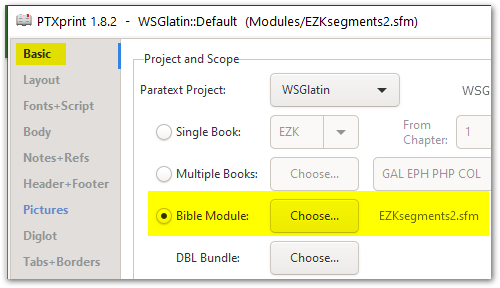
En PTXprint, puedes seleccionar un módulo desde la pestaña Basic (cuando la vista Advanced está habilitada):
Ten en cuenta que hay otros códigos que se pueden usar para hacer el módulo más interesante y estructurado. Por ejemplo, el siguiente módulo incluye un título de libro, nuevos encabezados de sección y referencias "localizadas" usando la notación $(EZK 1:22-27).
\id MOD Ezekiel segments
\mt2 Demo of the book of
\mt1 Ezekiel
\inc v
\s1 There is hope
\s2 Ezekiel's vision of God
\sr $(EZK 1:1-9)
\ref EZK 1:1-9
\sr $(EZK 1:22-27)
\ref EZK 1:22-27
\s2 God calls Ezekiel
\sr $(EZK 1:28-2:5)
\ref EZK 1:28-2:5
\s2 Sheep without a shepherd
\sr $(EZK 34:11-15)
\ref EZK 34:11-15
\s2 The valley of dry bones
\sr $(EZK 37:1-14)
\ref EZK 37:1-14
Producirá algo que se ve así:
Ten en cuenta que los números de capítulo \c pueden necesitar ocultarse a menos que estés comenzando desde el versículo 1. Y puede haber otras cosas que necesiten corregirse para obtener el resultado final que buscas.
@rickarellanes Thanks for this question. Obviously we don’t want to make this too easy for people to do - as we could quite easily (and inadvertently) end up with nicely formatted scripture with whole chunks missing, and possibly no one would notice. That’s far from ideal. So the aim of the “Bridge Empty Verses” toggle is to ensure that it is obvious that some of the text is missing.
But yes, if you intentionally want to only print certain parts of the text, then there is a way to do this. It is called a “Module”. And a module, in its simplest form, is essentially a list of references that you want extracted (and printed) from the text. Search Paratext’s help for “Module” and you’ll find some more information there. Here below, for example, is a module for the book of Ezekiel:
\ref EZK 1:1-9
\ref EZK 1:22-27
\ref EZK 1:28-2:5
\ref EZK 34:11-15
\ref EZK 37:1-14
Save that as a plain text file and put it in your project’s Modules folder, or in Paratext’s “_Modules” folder, and then you’ll be able to call that from PTXprint to produce a PDF with just those chunks of text.
In PTXprint you can select a module from the Basic tab (when Advanced view is enabled):
Note that there are other codes which can be used to make the module more interesting, and structured. So for example, the following module includes a book title, new section headings, and “localized” references using the $(EZK 1:22-27) notation.
\id MOD Ezekiel segments
\mt2 Demo of the book of
\mt1 Ezekiel
\inc v
\s1 There is hope
\s2 Ezekiel's vision of God
\sr $(EZK 1:1-9)
\ref EZK 1:1-9
\sr $(EZK 1:22-27)
\ref EZK 1:22-27
\s2 God calls Ezekiel
\sr $(EZK 1:28-2:5)
\ref EZK 1:28-2:5
\s2 Sheep without a shepherd
\sr $(EZK 34:11-15)
\ref EZK 34:11-15
\s2 The valley of dry bones
\sr $(EZK 37:1-14)
\ref EZK 37:1-14
Will produce something that looks like this:
Note that \c chapter numbers may need to be hidden unless you’re starting from verse 1. And there may be other things that need to be fixed to get the final result you’re looking for.
Traducción automática desde English








