Olá, John.
Uma maneira simples seria adicionar as frações como Sufixos Ordinais, na configuração de números.
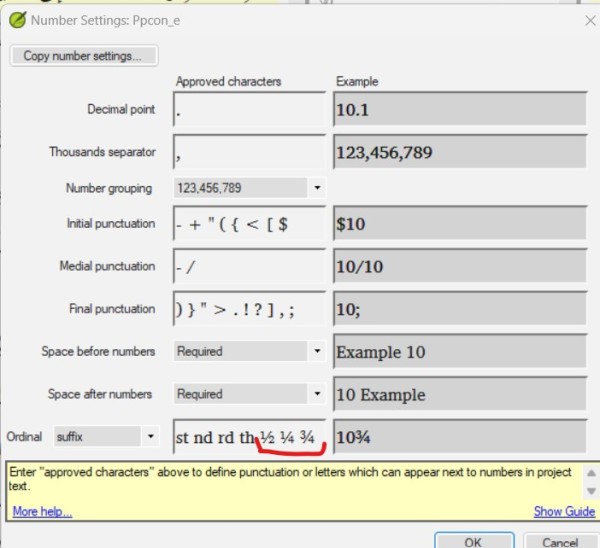
Dessa forma, a Verificação de Números considerará válido ter o número inteiro anexado à fração (4½). Você ainda precisará adicionar as frações como caracteres válidos no Inventário de Caracteres, para não ter erros na Verificação de Caracteres.
A desvantagem aqui é que, embora essas frações pareçam como você deseja, o Paratext não está, na verdade, tratando-as como números.
---
Outra maneira é colocar os números em forma inteira e usar a pontuação medial "/". Para o caso que você menciona, eles colocariam 4 1/2. O Paratext aceitará a diagonal se estiver configurado assim na Pontuação Medial das Configurações de Números. E eles terão que aprovar o / no Inventário de Caracteres para que não recebam um erro na Verificação de Caracteres.
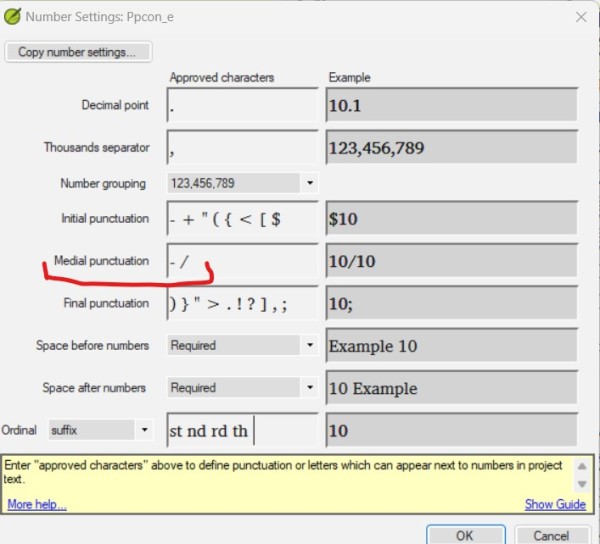
Quando você quiser imprimir, será fácil alterar, por exemplo, o 1/2 para ½ (00BD) e juntar esses dígitos a um número inteiro (4½)
----
Acho que qualquer outra maneira de forçar números como caracteres de idioma pode trazer mais riscos de erros do que benefícios.
Espero que isso ajude,
Pepe.
Hi John.
A simple way would be to add the fractions as Ordinal Suffixes, in the number configuration.
This way the Number Verification will consider valid to have the whole number attached to the fraction (4½). You will still need to add the fractions as valid characters in the Character Inventory, in order not to have errors in Character Verification.
The disadvantage here is that although these fractions look like you want them, Paratext is not actually treating them as numbers.
---
Another way is to put the numbers in integer form and use the medial punctuation "/". For the case you mention they would put 4 1/2. Paratext will accept the diagonal if it is set that way in the Medial Punctuation of the Number Settings. And they will have to approve the / in the Character Inventory so that they don't get an error in Character Verification.
When you want to print, it will be easy to change, for example, the 1/2 to ½ (00BD), and join these figures to a whole number (4½)
----
I think any other way of forcing numbers as language characters might bring more risks of errors than benefits.
I hope this helps,
Pepe.








