Hola, John.
Una forma sencilla sería añadir las fracciones como sufijos ordinales, en la configuración de números.
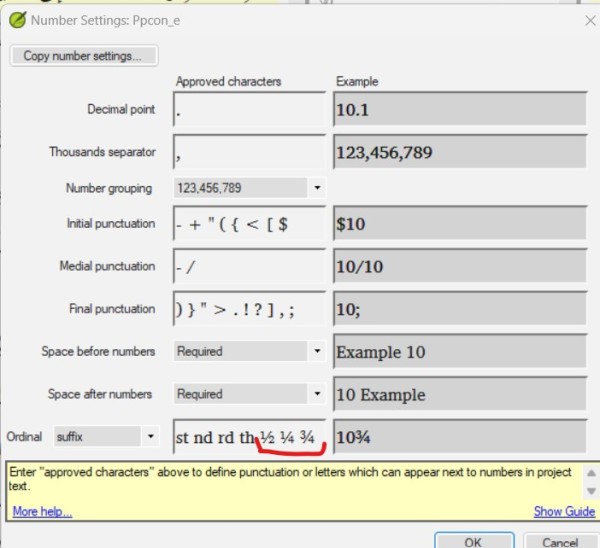
De esta manera, la Verificación de Números considerará válido tener el número entero unido a la fracción (4½). Aun así, necesitarán añadir las fracciones como caracteres válidos en el Inventario de Caracteres, para no tener errores en la Verificación de Caracteres.
La desventaja aquí es que, aunque estas fracciones se ven como las desean, Paratext no las está tratando realmente como números.
---
Otra forma es poner los números en forma entera y usar la puntuación medial "/". Para el caso que mencionan, pondrían 4 1/2. Paratext aceptará la diagonal si se configura así en la Puntuación Medial de la Configuración de Números. Y tendrán que aprobar la / en el Inventario de Caracteres para que no obtengan un error en la Verificación de Caracteres.
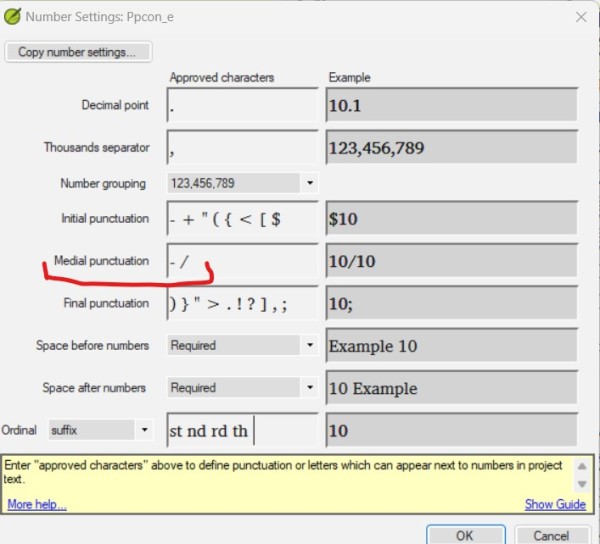
Cuando deseen imprimir, será fácil cambiar, por ejemplo, el 1/2 a ½ (00BD), y unir estas cifras a un número entero (4½)
----
Creo que cualquier otra forma de forzar números como caracteres del idioma podría traer más riesgos de errores que beneficios.
Espero que esto ayude,
Pepe.
Hi John.
A simple way would be to add the fractions as Ordinal Suffixes, in the number configuration.
This way the Number Verification will consider valid to have the whole number attached to the fraction (4½). You will still need to add the fractions as valid characters in the Character Inventory, in order not to have errors in Character Verification.
The disadvantage here is that although these fractions look like you want them, Paratext is not actually treating them as numbers.
---
Another way is to put the numbers in integer form and use the medial punctuation "/". For the case you mention they would put 4 1/2. Paratext will accept the diagonal if it is set that way in the Medial Punctuation of the Number Settings. And they will have to approve the / in the Character Inventory so that they don't get an error in Character Verification.
When you want to print, it will be easy to change, for example, the 1/2 to ½ (00BD), and join these figures to a whole number (4½)
----
I think any other way of forcing numbers as language characters might bring more risks of errors than benefits.
I hope this helps,
Pepe.