Saludos, Paula.
Al probarlo, veo que la verificación de referencias tomará tanto los “\x” como los “\f”.
Puede que no desee ver los “\f”, pero el resultado le permite notar fácilmente la diferencia entre uno y otro.
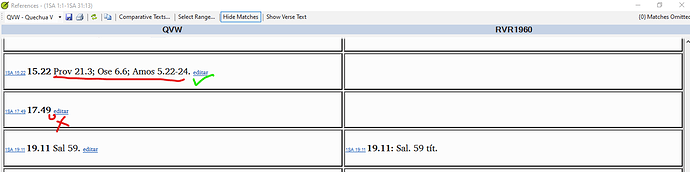
imagen1432×358 17.2 KB
Como muestra la imagen. A la izquierda tengo un proyecto de traducción y a la derecha un recurso de comparación.
A la izquierda, si hay una referencia cruzada, verá la cita bíblica (15.22) seguida por la cita paralela referenciada.
A diferencia de la segunda cita (17.49), que no va seguida de ninguna cita, porque corresponde a una nota al pie.
Así que es muy rápido notar cuáles de estos resultados son referencias cruzadas que no coinciden con su texto de comparación.
Si también utiliza la opción “Hide Matches”, reducirá el número de líneas que tiene que verificar.
Espero que esto sea útil,
anon689242.
Saludos Paula.
By testing I see that the reference check will take both the “\x” and the “\f”.
You might not want to see the “\f” but the result lets you easily notice the difference between one and the other.
image1432×358 17.2 KB
As the image shows. On the left I have a translation project and on the right a comparison resource.
On the left, if there is a cross-reference you will see the biblical quotation (15.22) followed by the referenced parallel quotation.
Unlike the second quotation (17.49) where it is not followed by any quotation, because it corresponds to a footnote.
So it is very quick to notice which of these results are cross-references that do not match your comparison text.
If you also use the “Hide Matches” option, you will reduce the number of lines you have to cross-reference.
I hope this is useful,
anon689242.