如果我对您的 FLEx 项目的副本仍然准确,那么您有 13 个可以放入属格槽位的词缀,以及 1 个可以放入关联格槽位的词缀。
蛮力方法是在您的 and 语句的第一部分检查是否存在那 1 个关联格词缀,第二部分则是一个长的 or 语句,用于检查与这 13 个词缀中的每一个是否相等。
实现第二部分的更简洁方法是检查词缀是否以 POSS1 或 POSS2 或 POSS3 结尾。它可能看起来像这样:
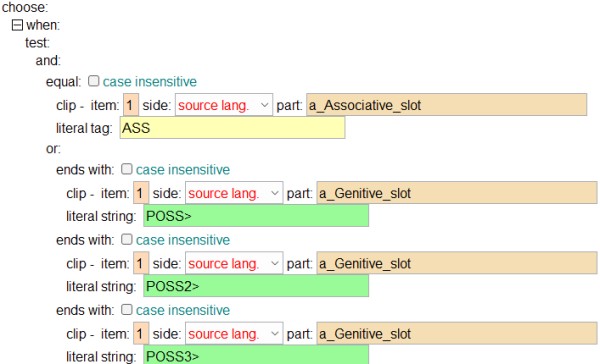
请注意,您不能在 ends with 语句中使用 literal tag,您必须使用 literal string 并以 > 结尾,这是标签的结束标记。
另一种方法是在类别定义中完成所有枚举。它可能看起来像这样:
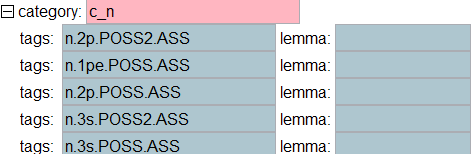
当然,这只是一个部分列表,您可能需要为每个名词类别(na, ni 等)添加更多项目。
这种方法的优点在于,您在类别中完成所有枚举,并使用该类别创建一条规则,此时您已经知道所有条件都已满足,因此可以进行所需的更改。
我很想知道您最终会选择哪种方法。
If my copy of your FLEx project is still accurate you have 13 affixes that could go in the genitive slot and 1 that can go in the associative slot.
The brute force method would be to have the first part of your and statement check if the 1 associative affix is present, the second part of your and statement would be a long or statement that would check equality with each of the 13 affixes.
A less long way to do the second part would be to check if the affix ends with POSS1 or POSS2 or POSS3. It might look like this:
Note that you can't use a literal tag with the ends with statement you have to use literal string and end it with a > which is the end marker for a tag.
A different approach would be to do all the enumerating in category definition. It might look like this:
Of course, this is just a partial list and you may have to add to the list for each of your noun categories. na, ni, etc.
The advantage of this, is you do all the enumerating in the category and have a rule using that category where you already know all the conditions have been met and you can do the changes needed.
I'd be curious to know what you end up choosing to do.
机器翻译自 English








